The Sentence That Isn't in Executive Order 14421
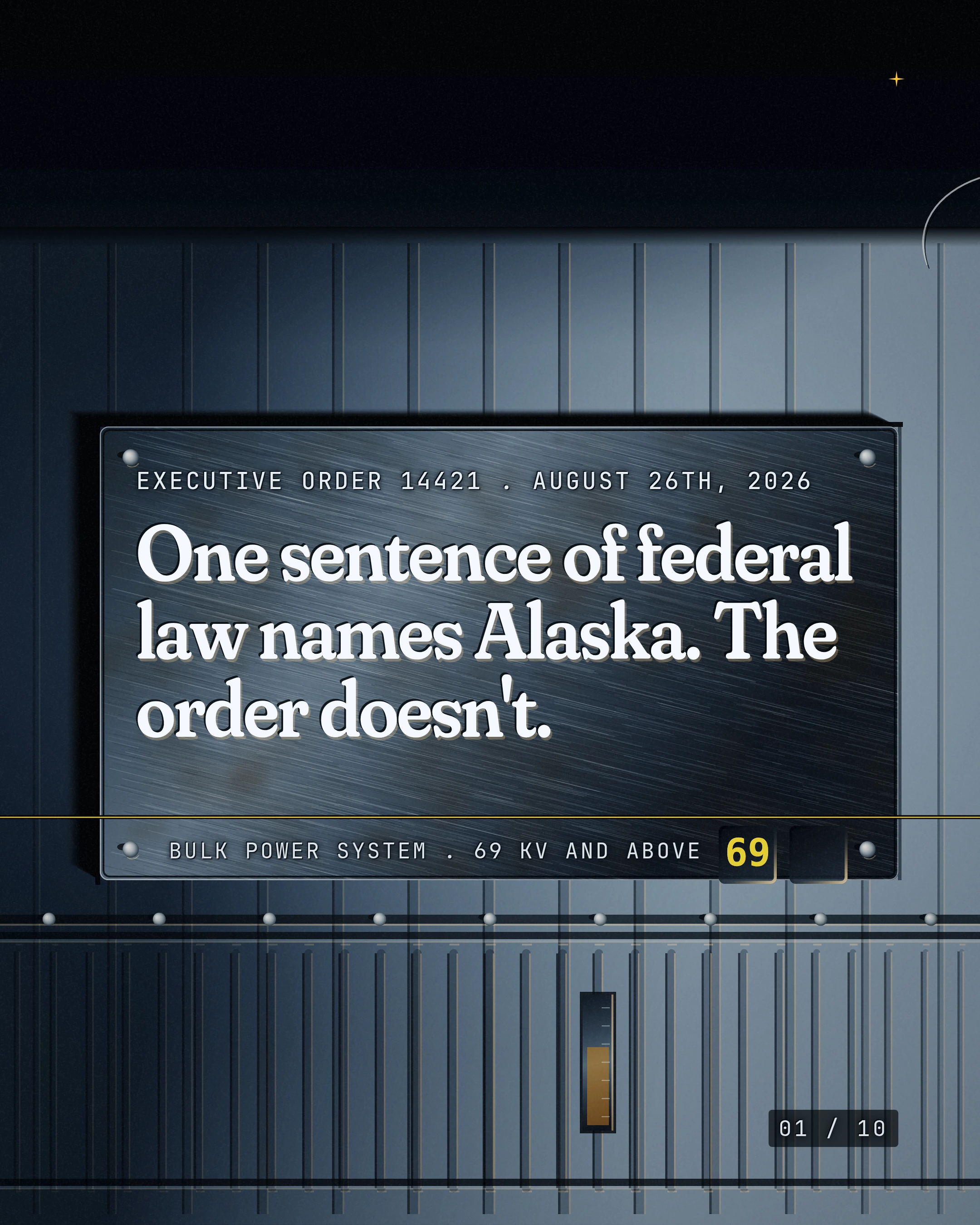
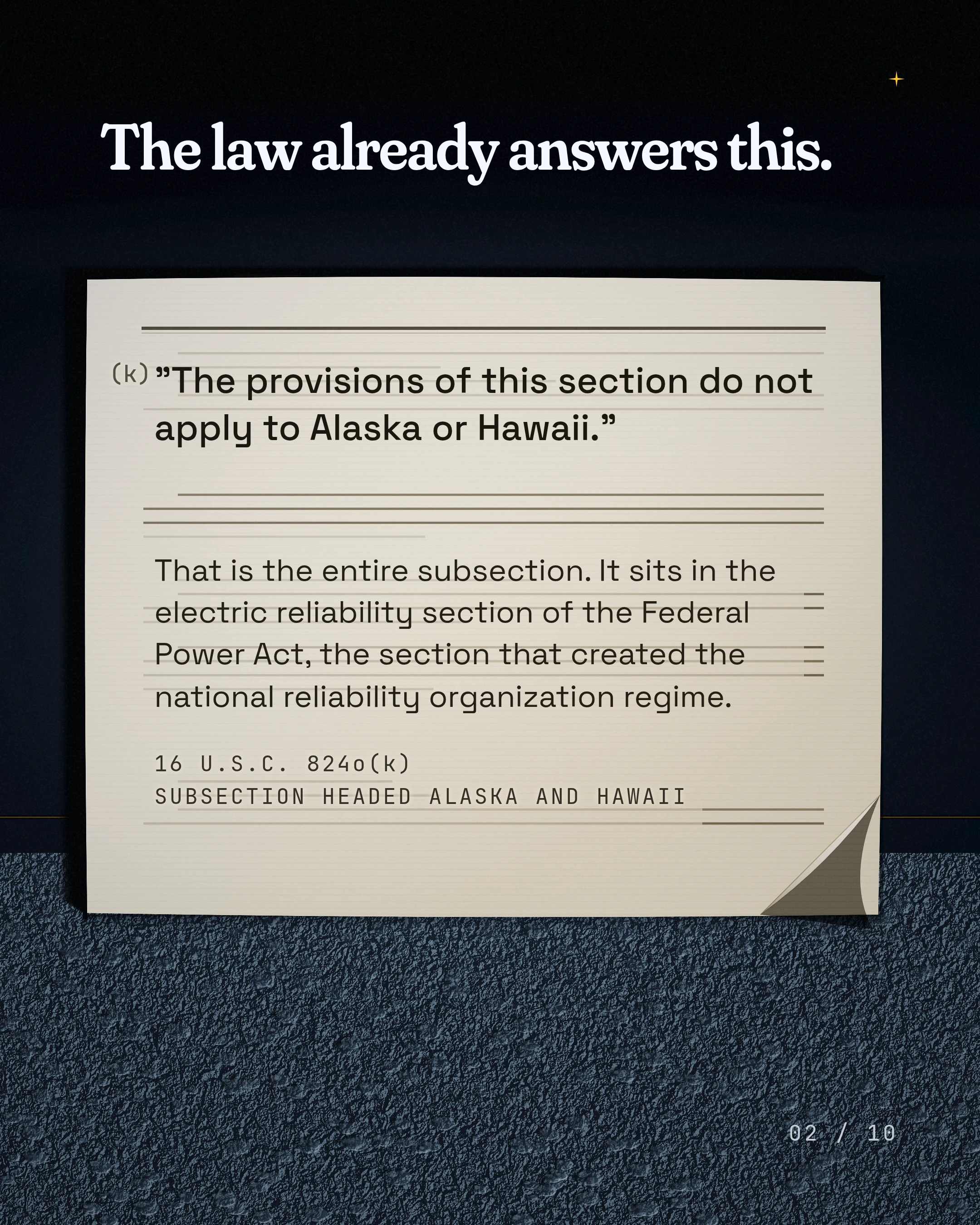
One sentence in federal law says the grid reliability rules don't apply to Alaska. Executive Order 14421 carries no sentence like it.
The deck
SWIPE, SCROLL OR CLICK A SLIDE TO GO FULLSCREEN · 10 SLIDES
The story
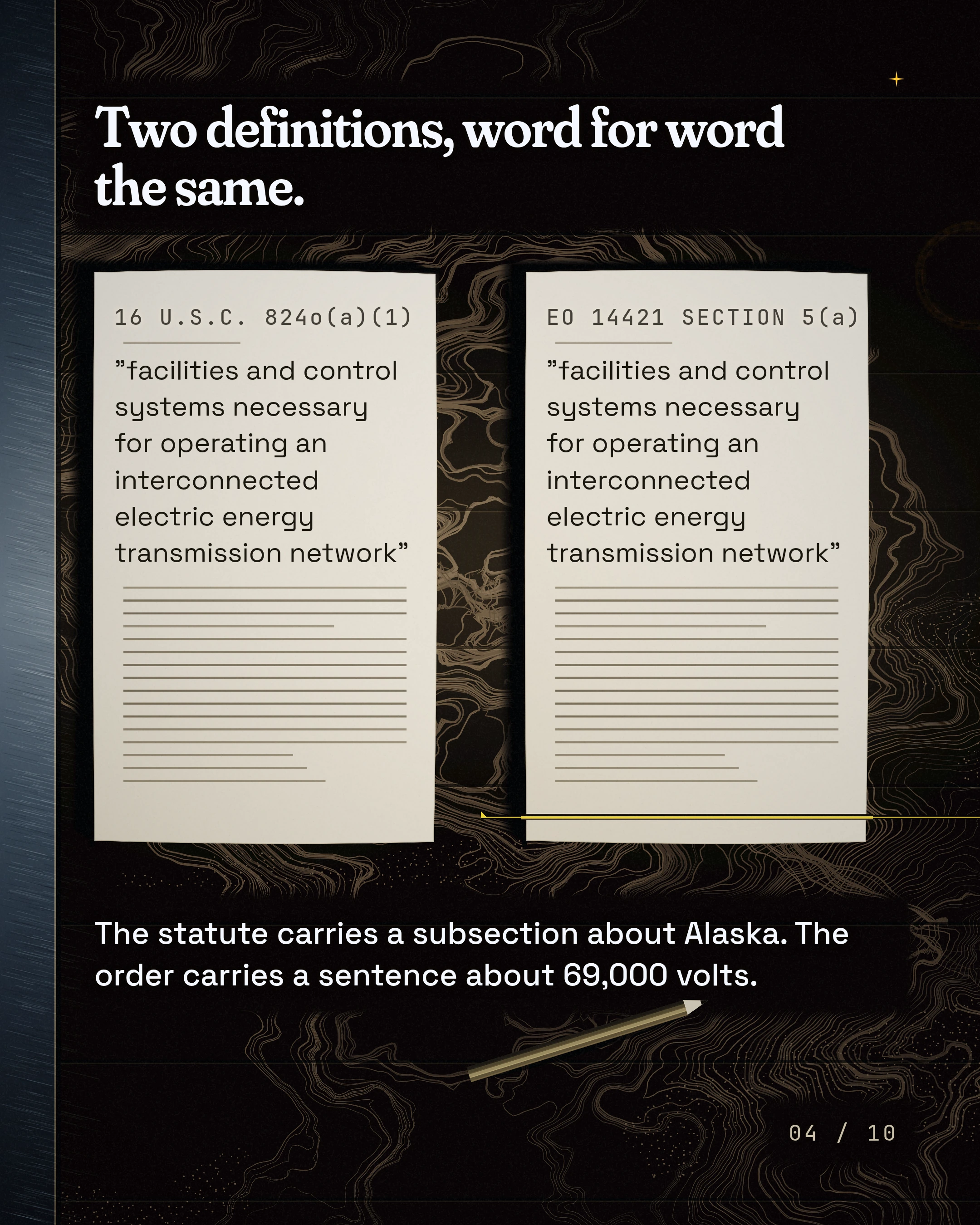
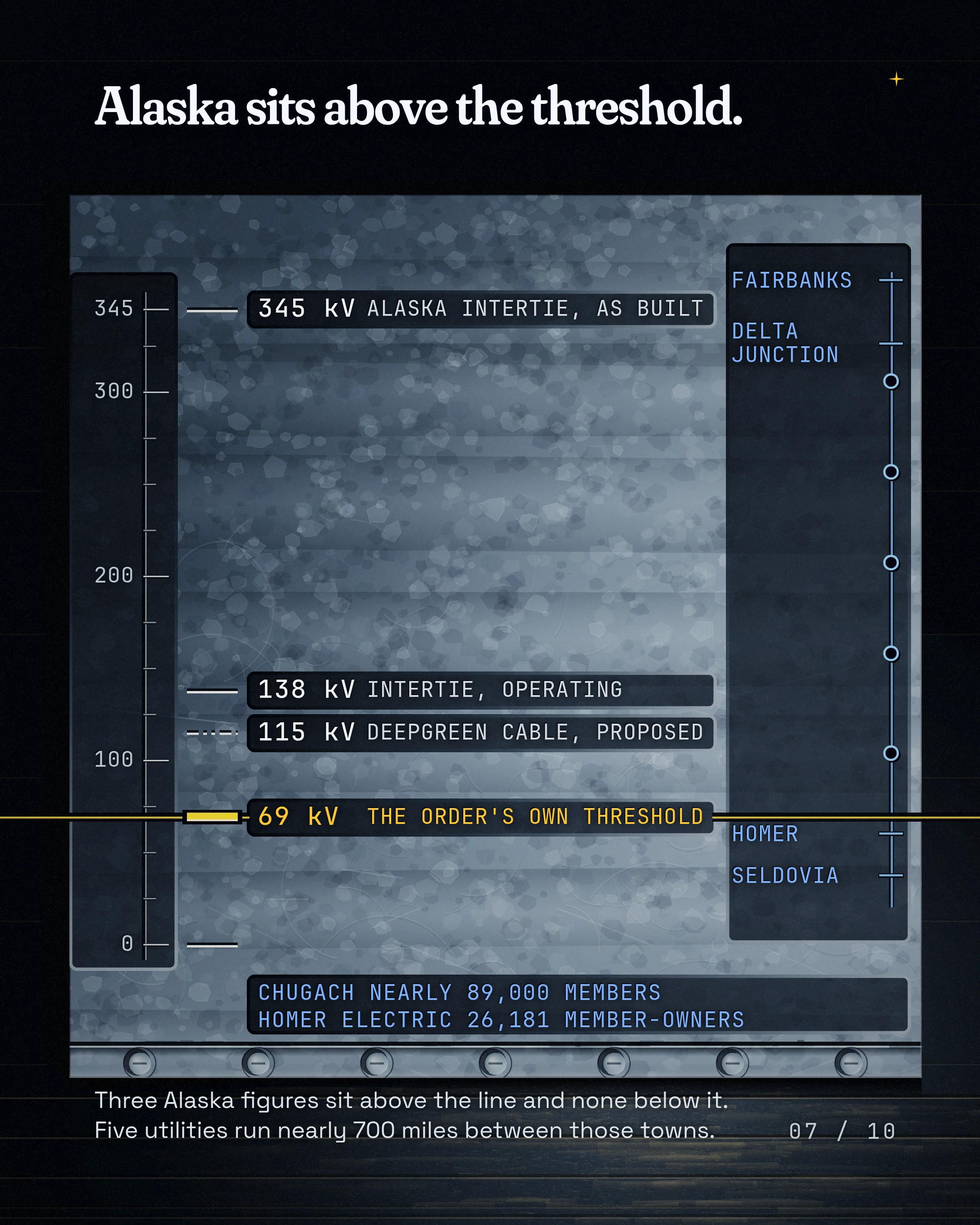
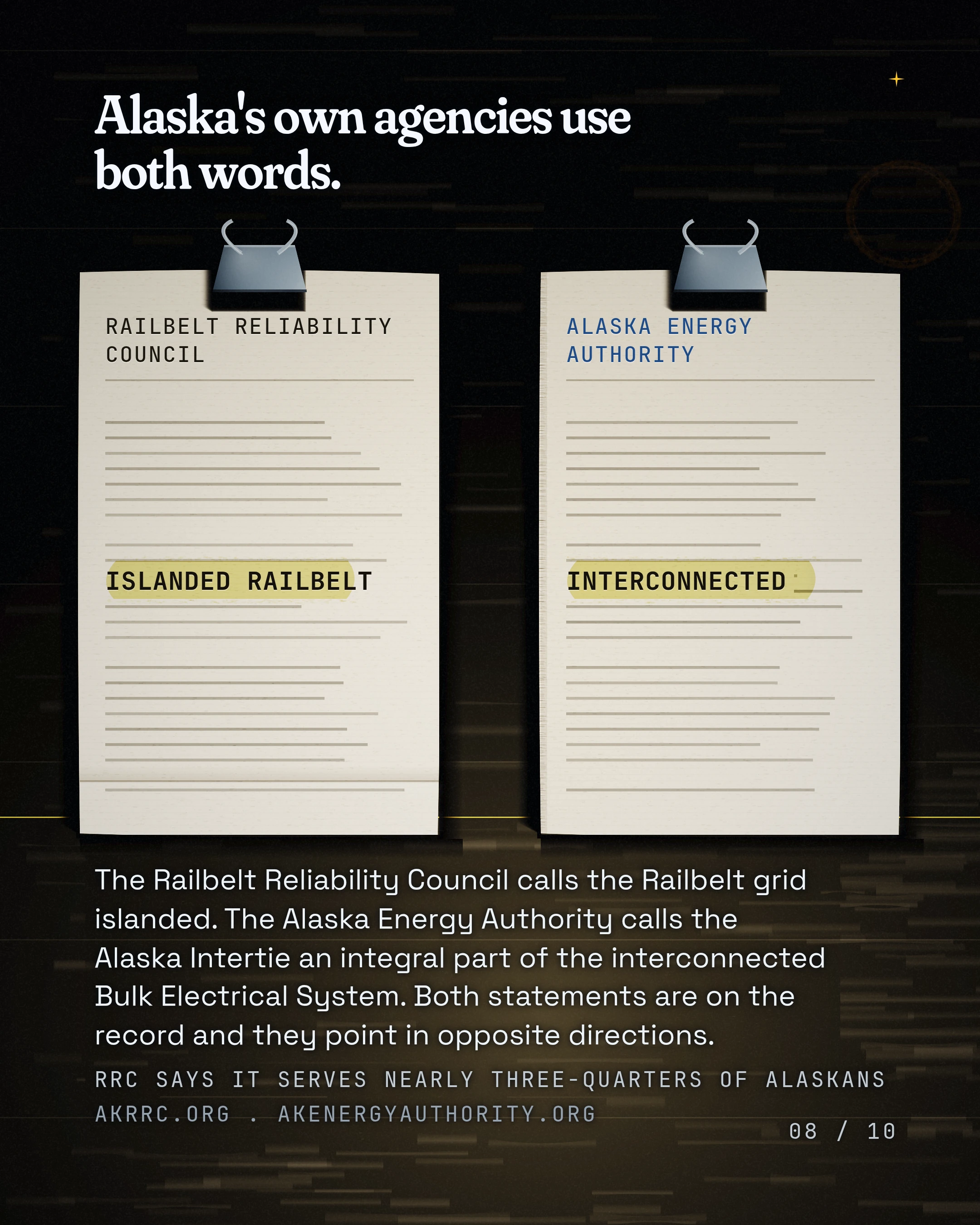
The order borrows the statute's definition of the bulk-power system almost word for word. It adds a threshold the statute never had at 69,000 volts. The Alaska Energy Authority puts the Alaska Intertie at 138 kilovolts and calls it part of the interconnected Bulk Electrical System. The Railbelt Reliability Council calls the same grid islanded.
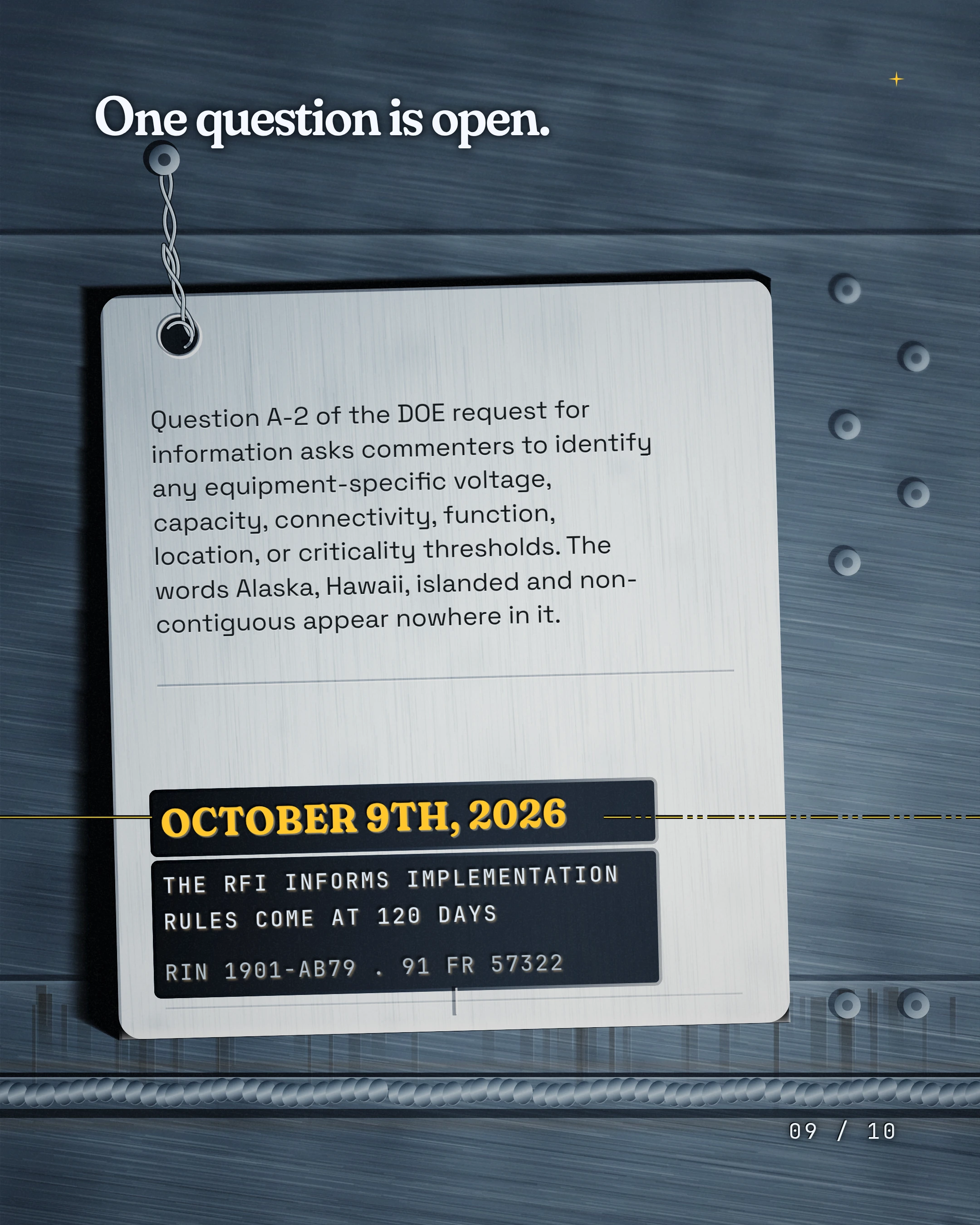
DOE takes written comments through October 9th, 2026. Its rules are due 120 days from the order.
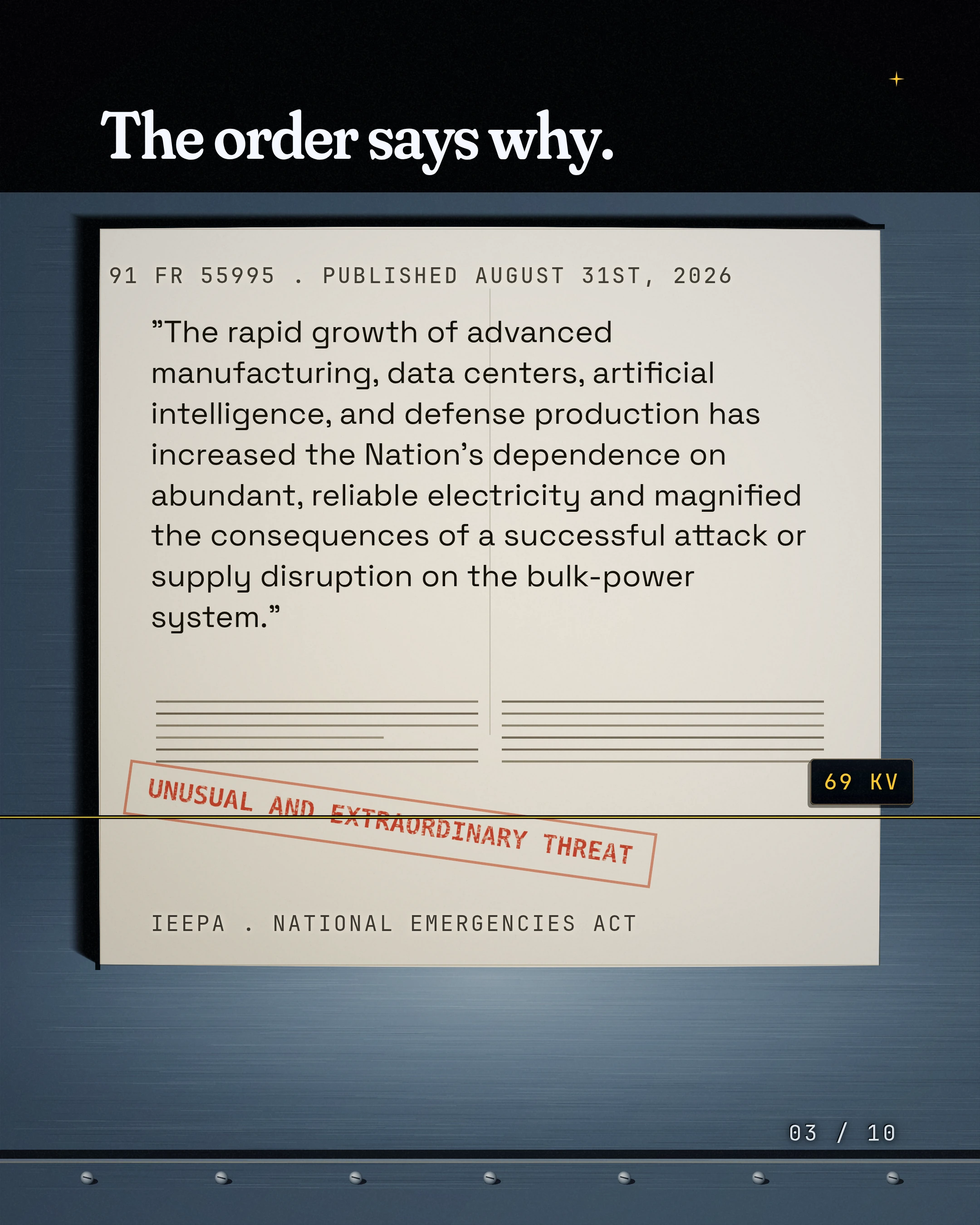
Both definitions sit side by side in the deck at identical size, and the order's stated reason names data centers and artificial intelligence.
Which Alaska institution should put the Railbelt's voltages in front of DOE before that window closes?
What we verified
41 CLAIMS, EACH RE-FETCHED FROM ITS SOURCE BEFORE THIS DECK SHIPPED
Executive Order 14421 is dated August 26th, 2026.
The title of Executive Order 14421 is Declaring a National Emergency To Secure the United States Bulk-Power System.
Executive Order 14421 was published in the Federal Register on August 31st, 2026 beginning at page 55995 of volume 91.
The order's stated rationale names data centers and artificial intelligence as drivers of the Nation's dependence on reliable electricity.
Section 5(a) of the order defines the bulk-power system around facilities necessary for operating an interconnected electric energy transmission network.
The order's own definition covers transmission lines rated at 69,000 volts or more and excludes local distribution facilities.
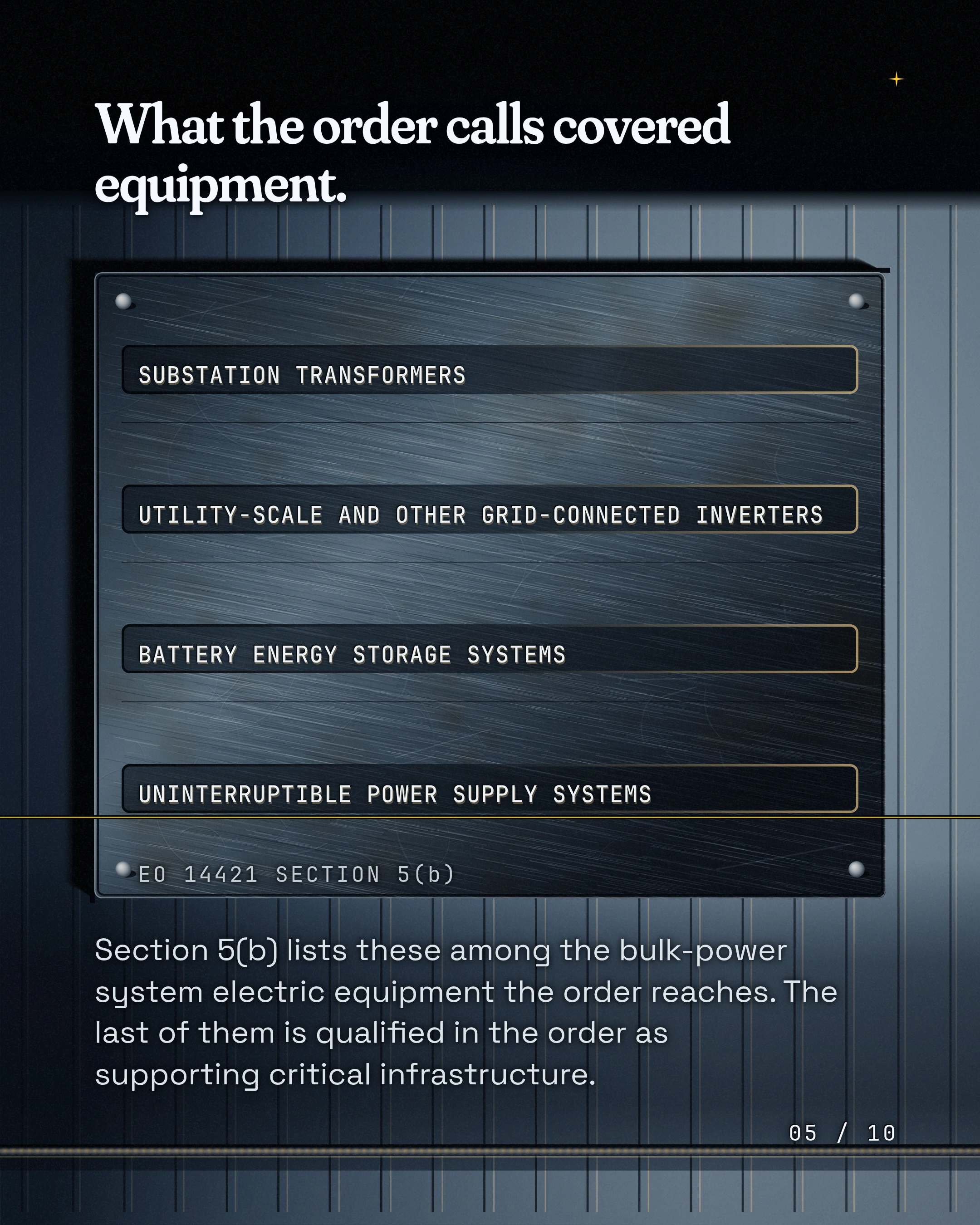
Section 5(b) lists substation transformers, grid-connected inverters, battery energy storage systems and uninterruptible power supply systems among covered bulk-power system electric equipment.
The order is issued under the International Emergency Economic Powers Act and the National Emergencies Act.
The order declares a national emergency with respect to the foreign supply of bulk-power system electric equipment.
The order gives the Secretary of Energy 120 days to publish rules or regulations implementing its authorities.
The order gives the Secretary of Energy 180 days to submit recommended revisions to the Federal Acquisition Regulation.
No geographic exclusion appears in the text of Executive Order 14421 as published, and the words Alaska, Hawaii, islanded and non-contiguous appear nowhere in it.
The Department of Energy Office of Cybersecurity, Energy Security, and Emergency Response published a request for information titled Securing the United States Bulk-Power System.
The DOE request for information was published on September 9th, 2026 starting at page 57322 of Federal Register volume 91.
The DOE request for information carries the Regulation Identifier Number 1901-AB79.
Comments on the DOE request for information are accepted on or before October 9th, 2026.
Question A-2 of the request for information asks commenters to identify equipment-specific voltage, capacity, connectivity, function, location or criticality thresholds.
DOE states the request for information is meant to inform its actions to implement the executive order.
The DOE request for information as published raises no geographic or islanded system question, and the words Alaska, Hawaii, islanded and non-contiguous appear nowhere in it.
Section 215 of the Federal Power Act states that its provisions do not apply to Alaska or Hawaii.
The Railbelt Reliability Council describes itself as Alaska's first electric reliability organization.
The Railbelt Reliability Council calls the Railbelt grid islanded.
The interconnected Railbelt bulk electric system serves a geographic area entirely inside Alaska.
Five load-serving electric utilities are interconnected on the Alaska Railbelt.
The Railbelt Reliability Council says the Railbelt grid serves nearly three-quarters of Alaska's population.
The Railbelt utilities are interconnected across nearly 700 miles.
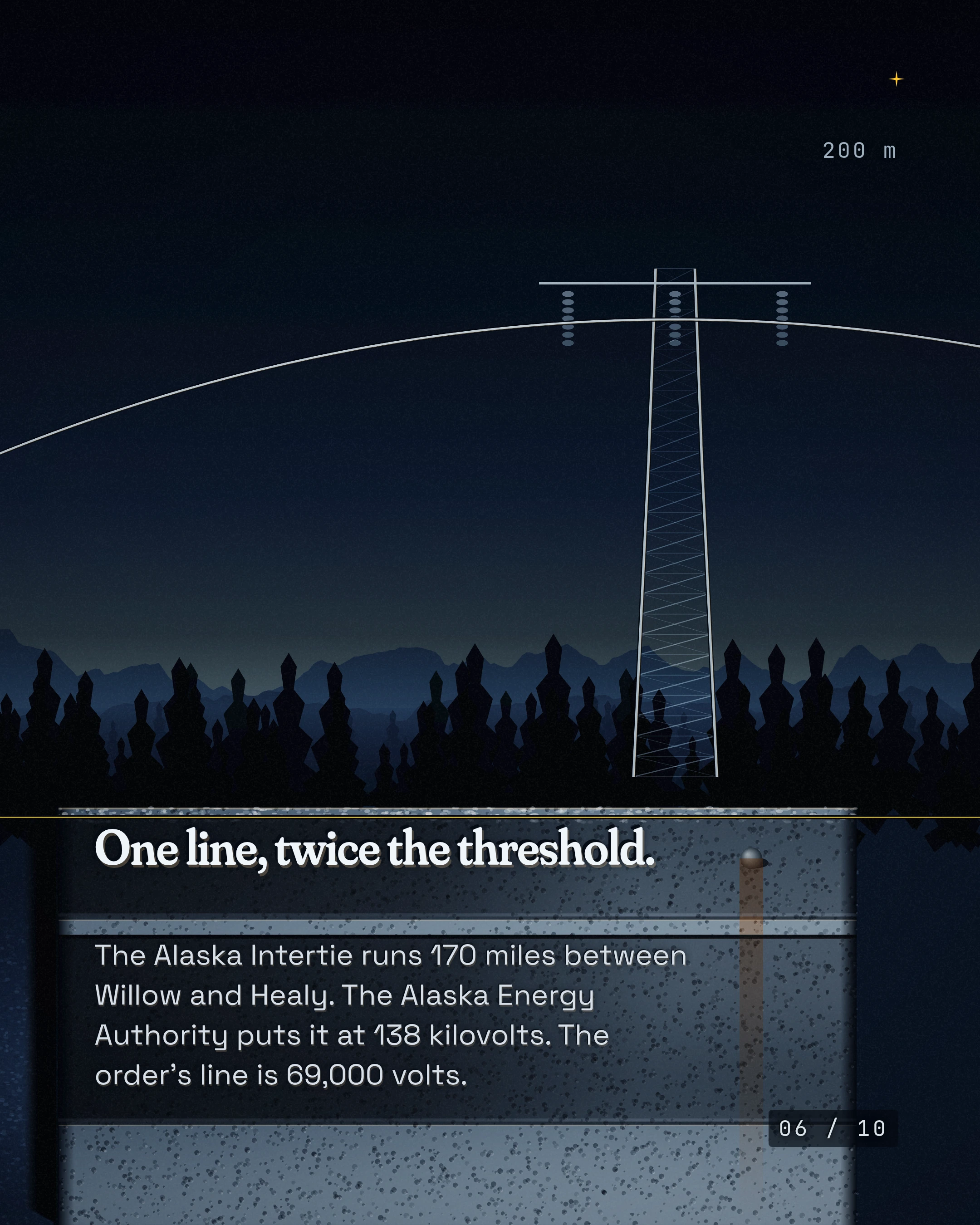
The Alaska Intertie is owned by the Alaska Energy Authority and runs 170 miles between Willow and Healy.
The Alaska Intertie was built to 345 kilovolt standards and operates at 138 kilovolts, per the Alaska Energy Authority.
The Alaska Energy Authority calls the Alaska Intertie an integral part of the interconnected bulk electrical system for the Railbelt region.
Chugach Electric Association serves nearly 89,000 members at over 113,000 metered locations.
Homer Electric Association reports 26,181 member-owners.
Alaska generated 6,690,506 megawatthours of electricity in 2024.
Alaska's average retail electricity price across all sectors in 2024 was 22.17 cents per kilowatthour.
FERC accepted for filing a preliminary permit application from DeepGreen Cook Inlet SPV, LLC under Project No. 15423-000.
The DeepGreen Cook Inlet project proposes an approximately 3.5 mile 115 kilovolt hybrid power and fiber-optic armored subsea cable.
The DeepGreen Cook Inlet project proposes 66 modular subsea-compute hives described as data center pods.
The DeepGreen Cook Inlet project proposes approximately 330 to 350 marine hydrokinetic turbines.
The FERC notice puts the DeepGreen project's estimated annual generation at 100 megawatts.
Comments and competing applications on the DeepGreen preliminary permit are due by 5 p.m. Eastern on November 2nd, 2026.
16 U.S.C. 824o is the Federal Power Act electric reliability section that created the national electric reliability organization regime.
The Federal Power Act reliability section defines the bulk-power system in nearly the same words the executive order uses.
Beats
This article is on Alaska data centers · Alaska power and the grid · Alaska land and permitting for AI · Defense and federal AI in Alaska · Alaska AI policy and legislation. Each beat page keeps every decision and every article on that subject in one place.