Alaska's Half Vote and a Federal Bill
"The Ratepayer Protection Act will ensure that data centers pay their own way, instead of passing costs onto hardworking families."
The deck
SWIPE, SCROLL OR CLICK A SLIDE TO GO FULLSCREEN · 9 SLIDES
The story
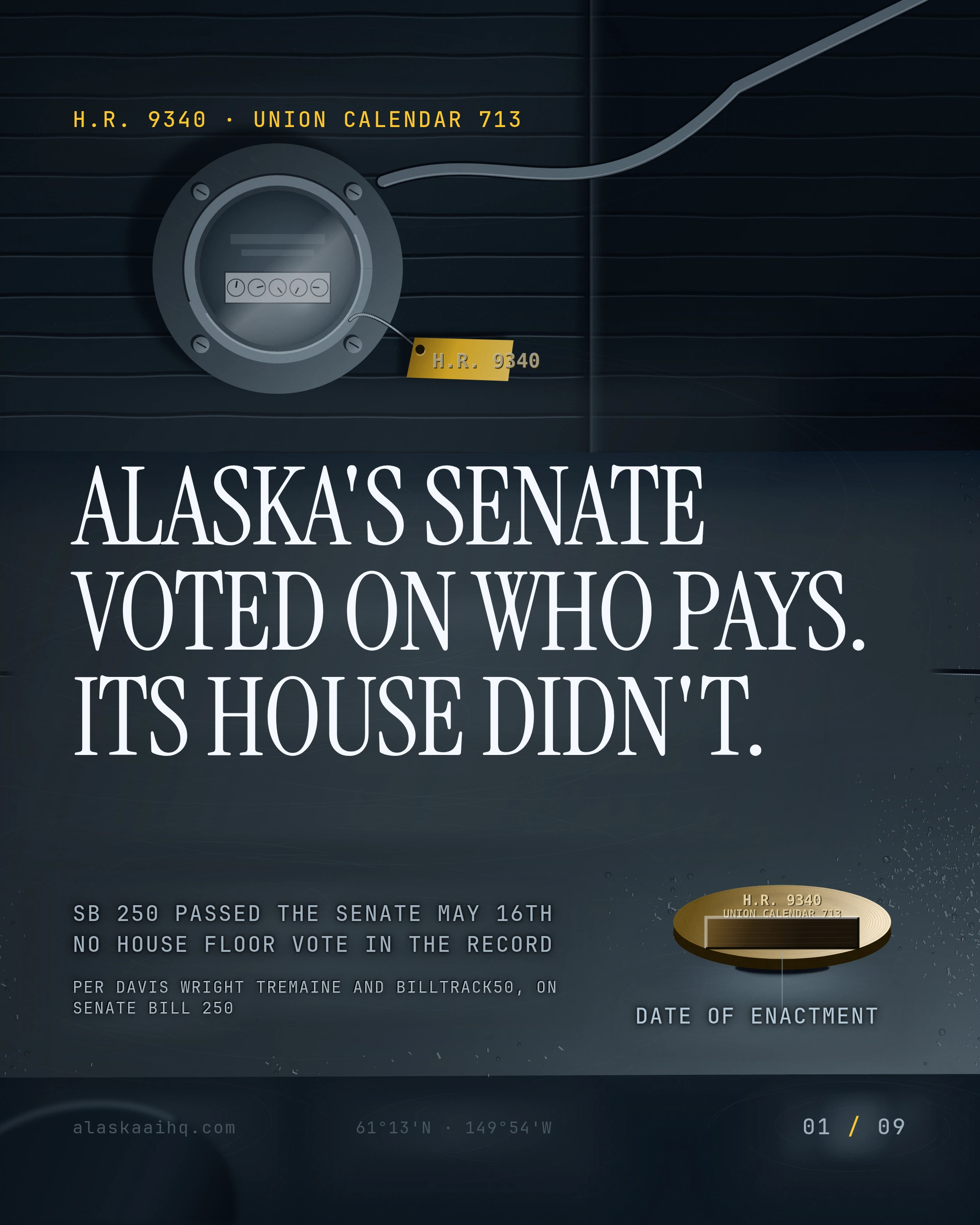
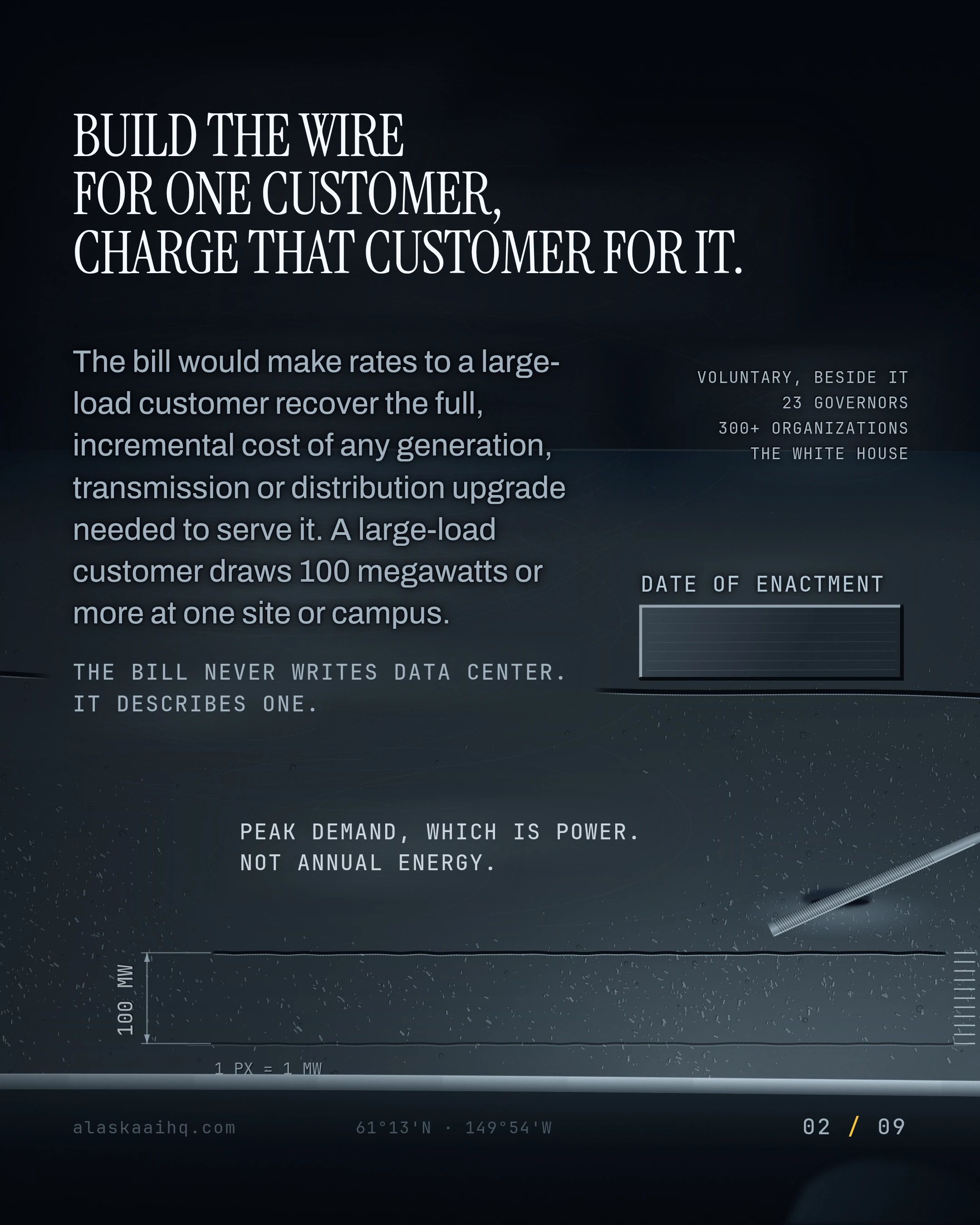
Energy and Commerce Chairman Brett Guthrie said that when his committee advanced H.R. 9340 by 52 to 0. The bill never writes "data center". It describes one, a customer with 100 megawatts or more of peak demand who would pay the full incremental cost of the grid built to serve it.
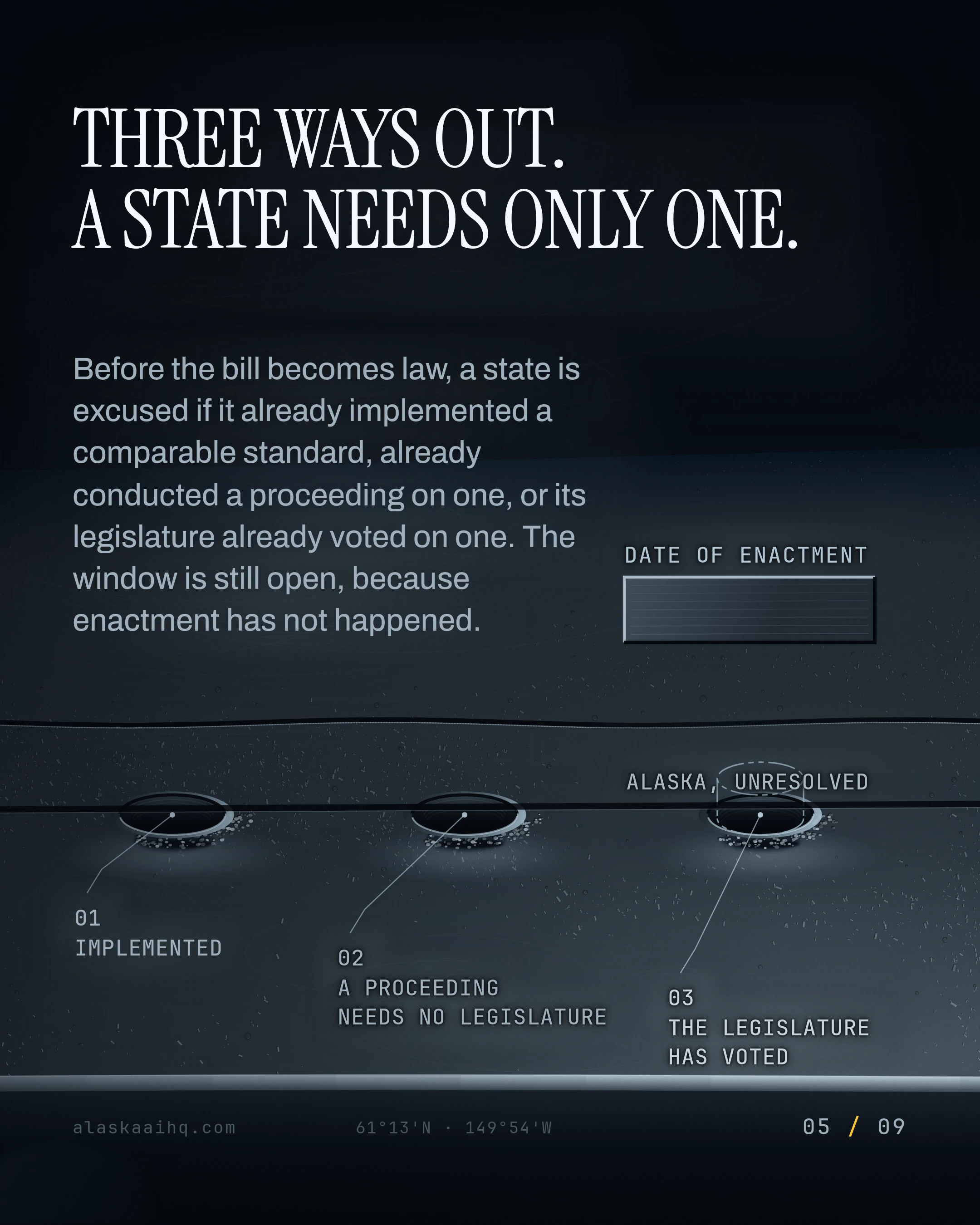
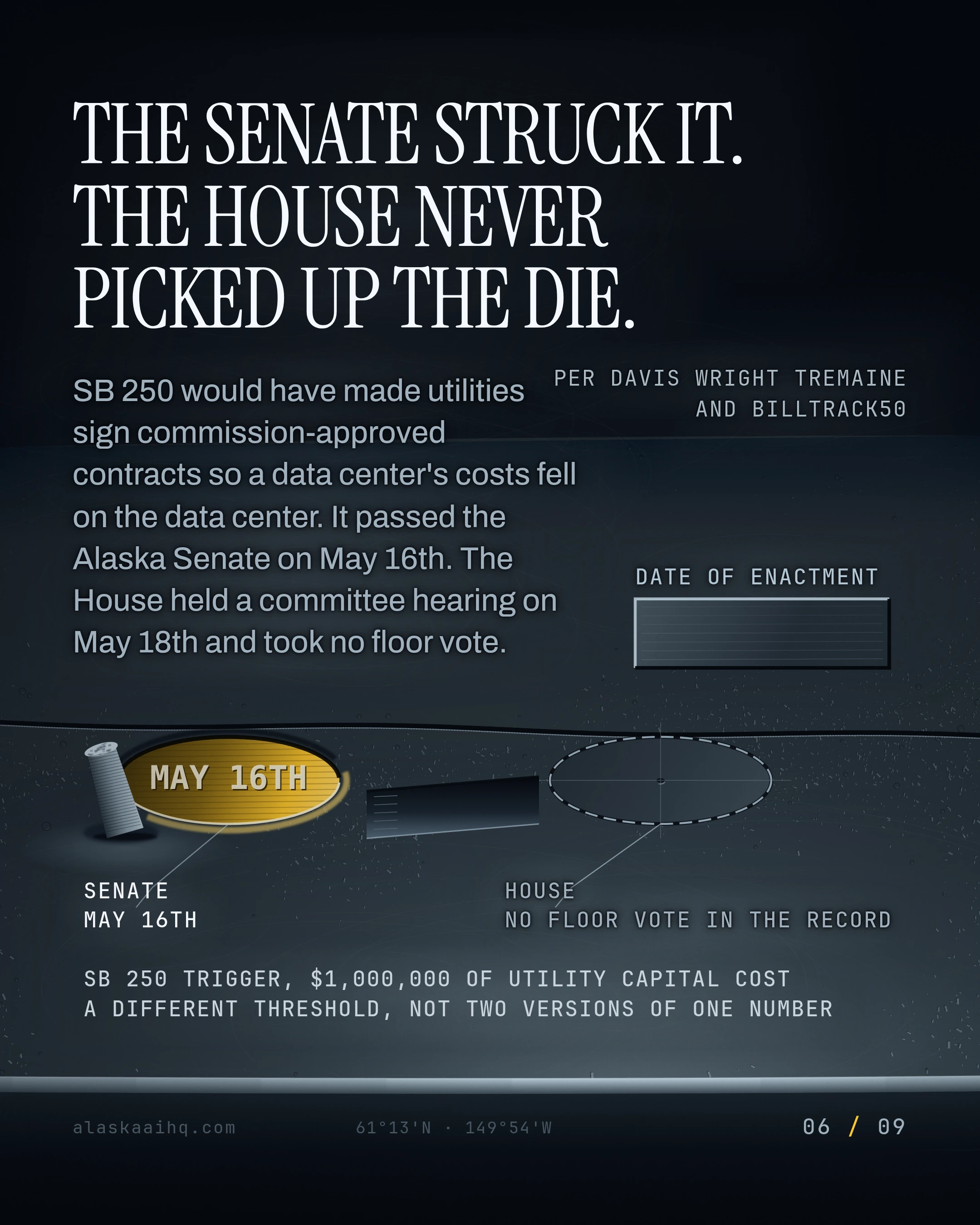
A state whose legislature already voted on a comparable standard would be excused. Alaska's Senate passed SB 250 on May 16th, per Davis Wright Tremaine. No House floor vote appears in the public record.
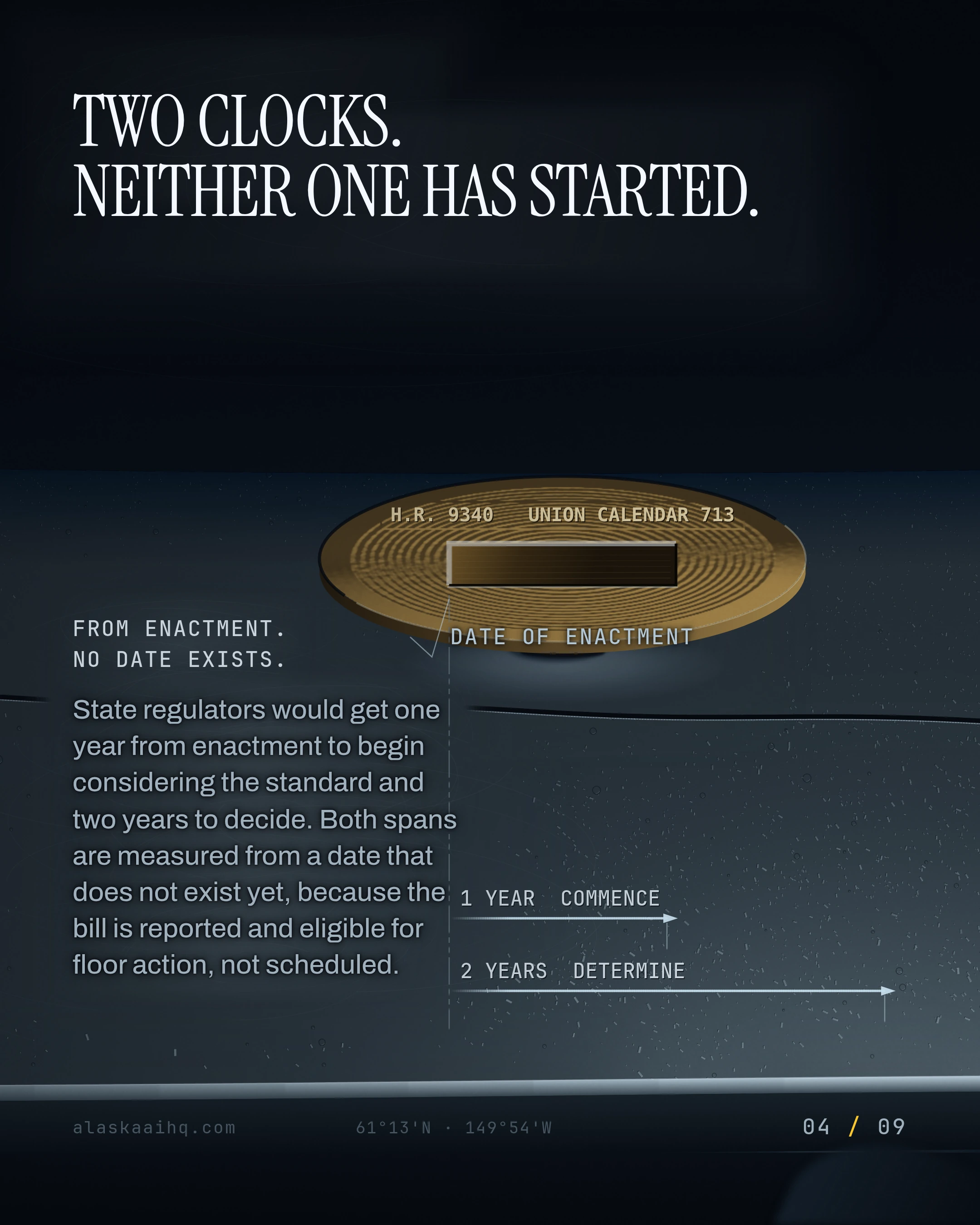
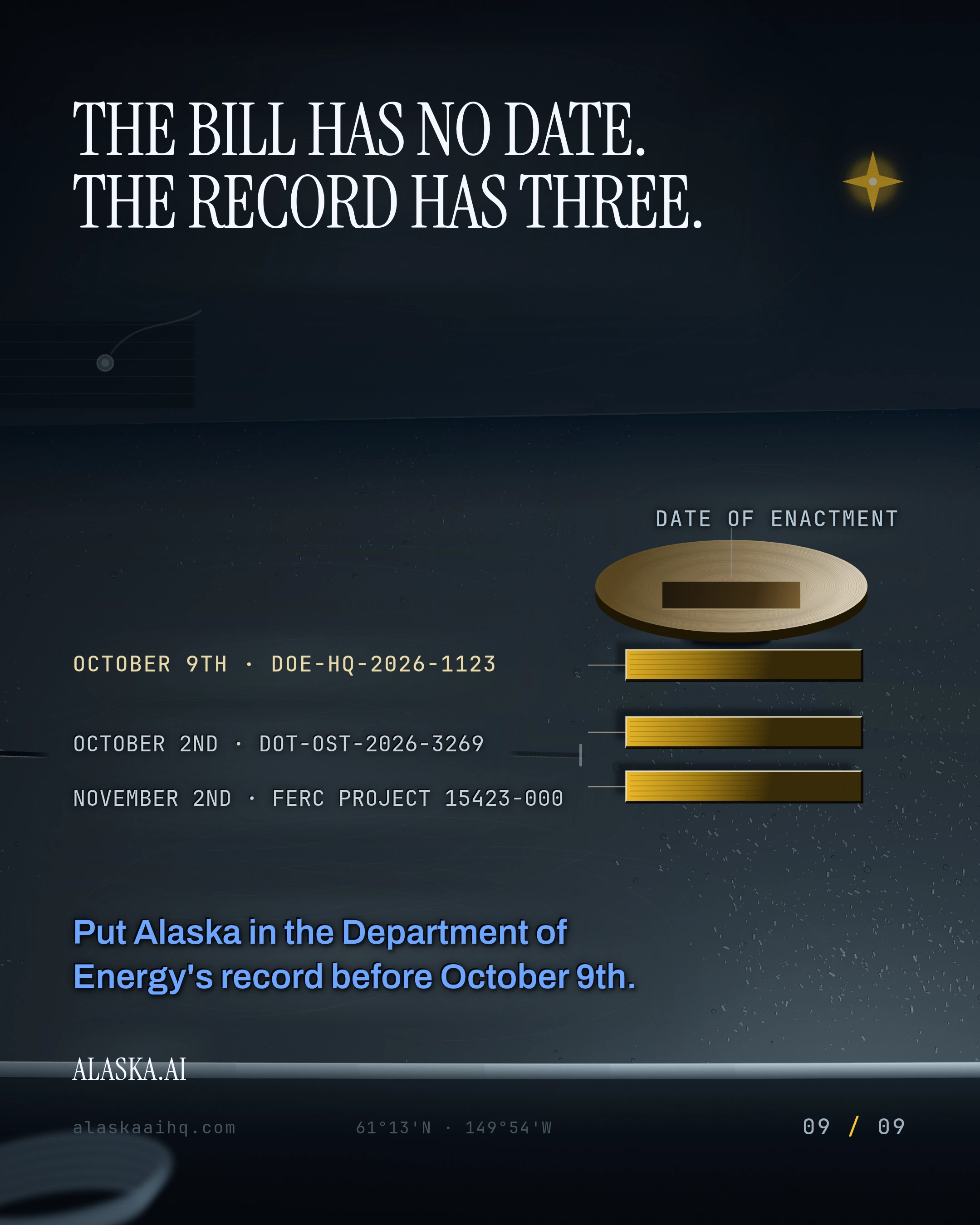
A field labeled DATE OF ENACTMENT stays bare on all nine frames, because the bill is reported and on no published schedule.
The Department of Energy's record closes October 9th. What would Alaska's line in that record have to admit?
What we verified
46 CLAIMS, EACH RE-FETCHED FROM ITS SOURCE BEFORE THIS DECK SHIPPED
The short title of H.R. 9340 is the Ratepayer Protection Act.
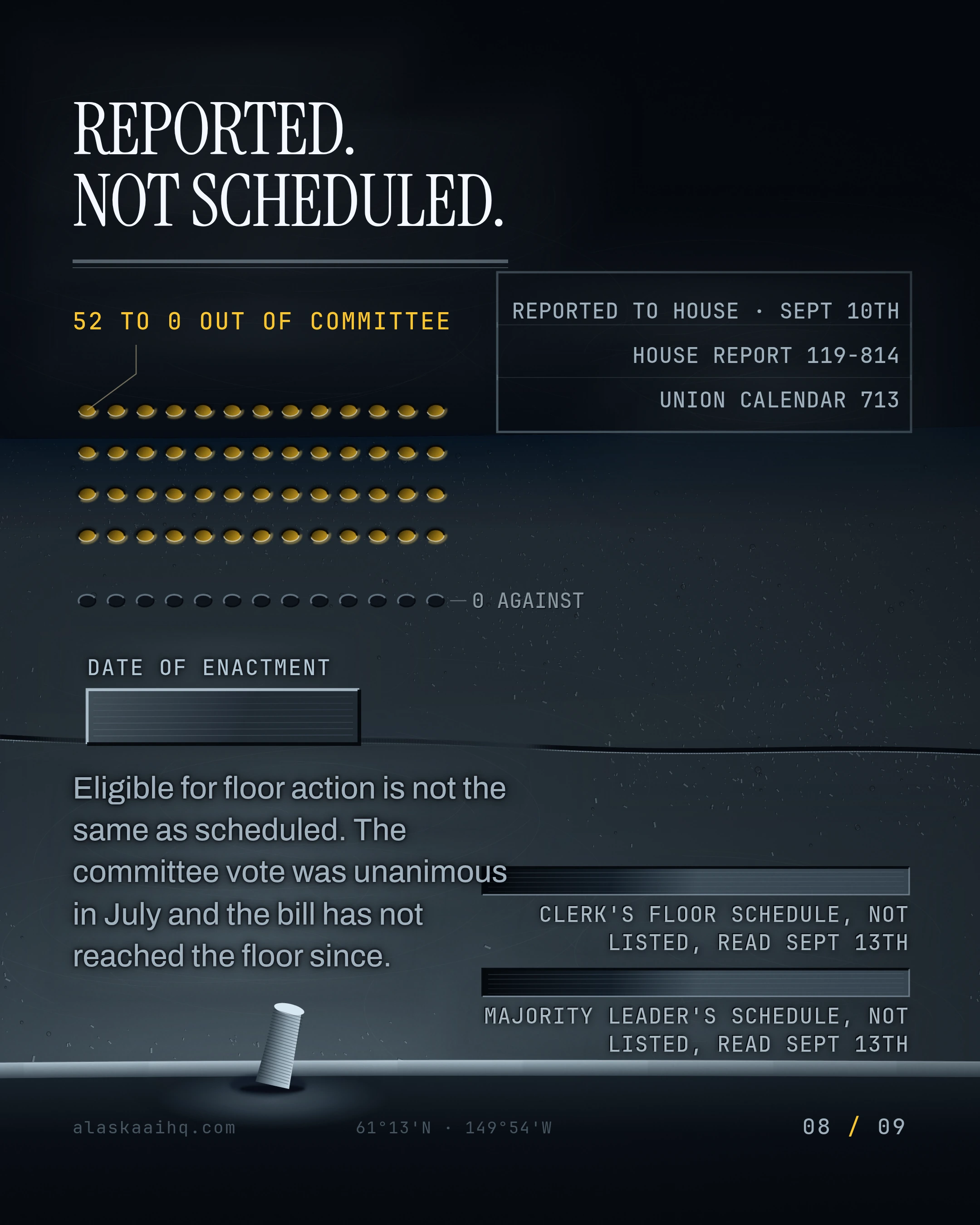
The reported version of H.R. 9340 carries House Report number 119-814.
H.R. 9340 sits on the Union Calendar as number 713.
H.R. 9340 was reported in the House on September 10th, 2026 in the second session of the 119th Congress.
H.R. 9340 defines a large-load customer around a peak electric demand of 100 megawatts or more.
The 100 megawatt threshold in H.R. 9340 is measured at a single site or campus.
H.R. 9340 reaches customers whose facilities require electric energy primarily to operate information technology infrastructure for data storage and computational applications.
The large-load customer definition in H.R. 9340 applies only to a non-residential consumer requesting or entering a contract on or after the date of enactment.
H.R. 9340 would require rates to a large-load customer to be designed to recover the full, incremental cost of any generation, transmission or distribution upgrade needed to serve that customer.
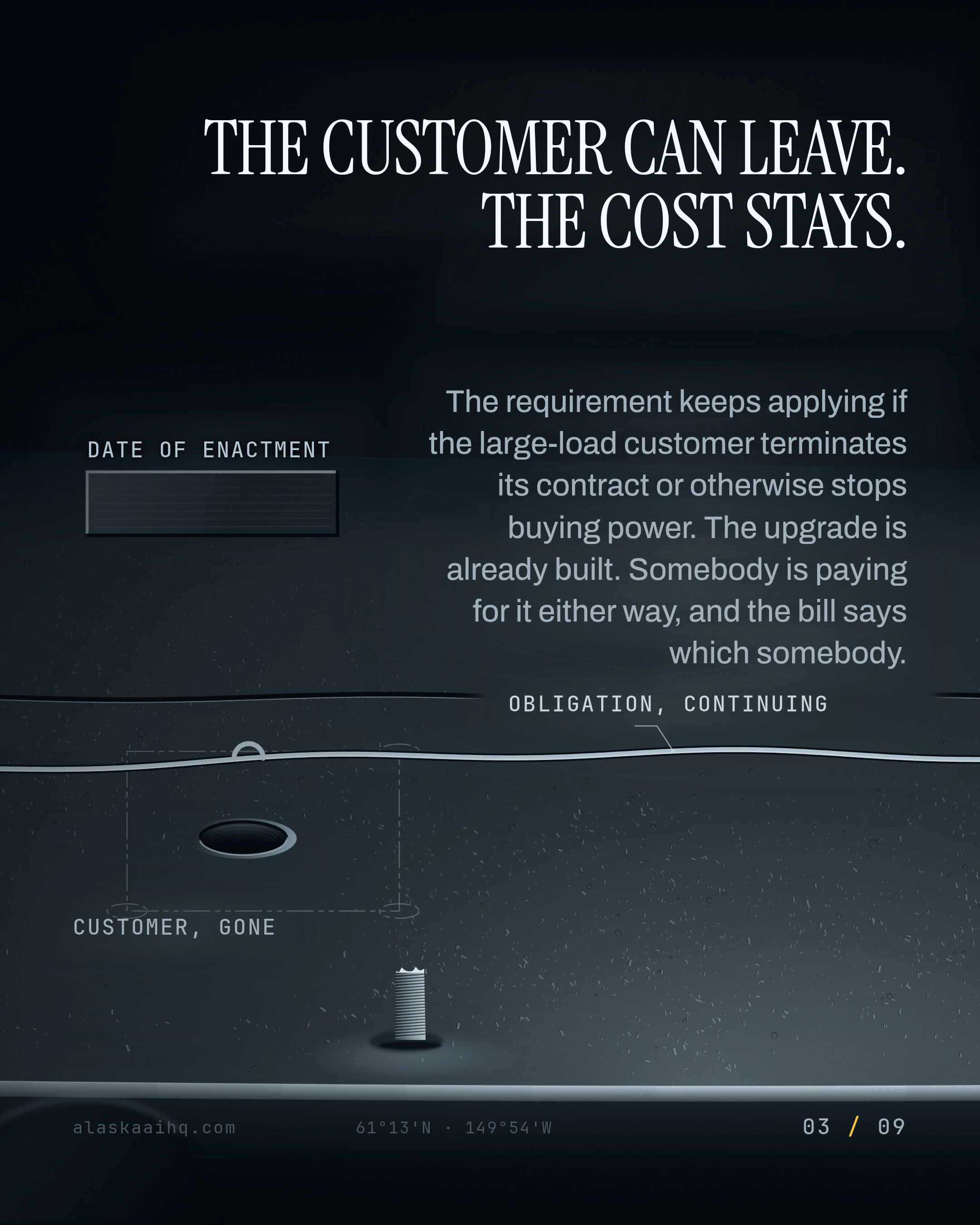
The cost recovery requirement in H.R. 9340 continues to apply if the large-load customer terminates its contract or stops buying power.
H.R. 9340 gives each State regulatory authority one year after enactment to commence consideration of the standard or set a hearing date.
H.R. 9340 gives each State regulatory authority two years after enactment to complete consideration and make a determination.
H.R. 9340 excuses a state from the consideration requirement if the state acted before the date of enactment of the subsection.
The first way a state qualifies for the H.R. 9340 exemption is having already implemented the standard or a comparable standard.
The second way a state qualifies for the H.R. 9340 exemption is having conducted a proceeding to consider implementing the standard.
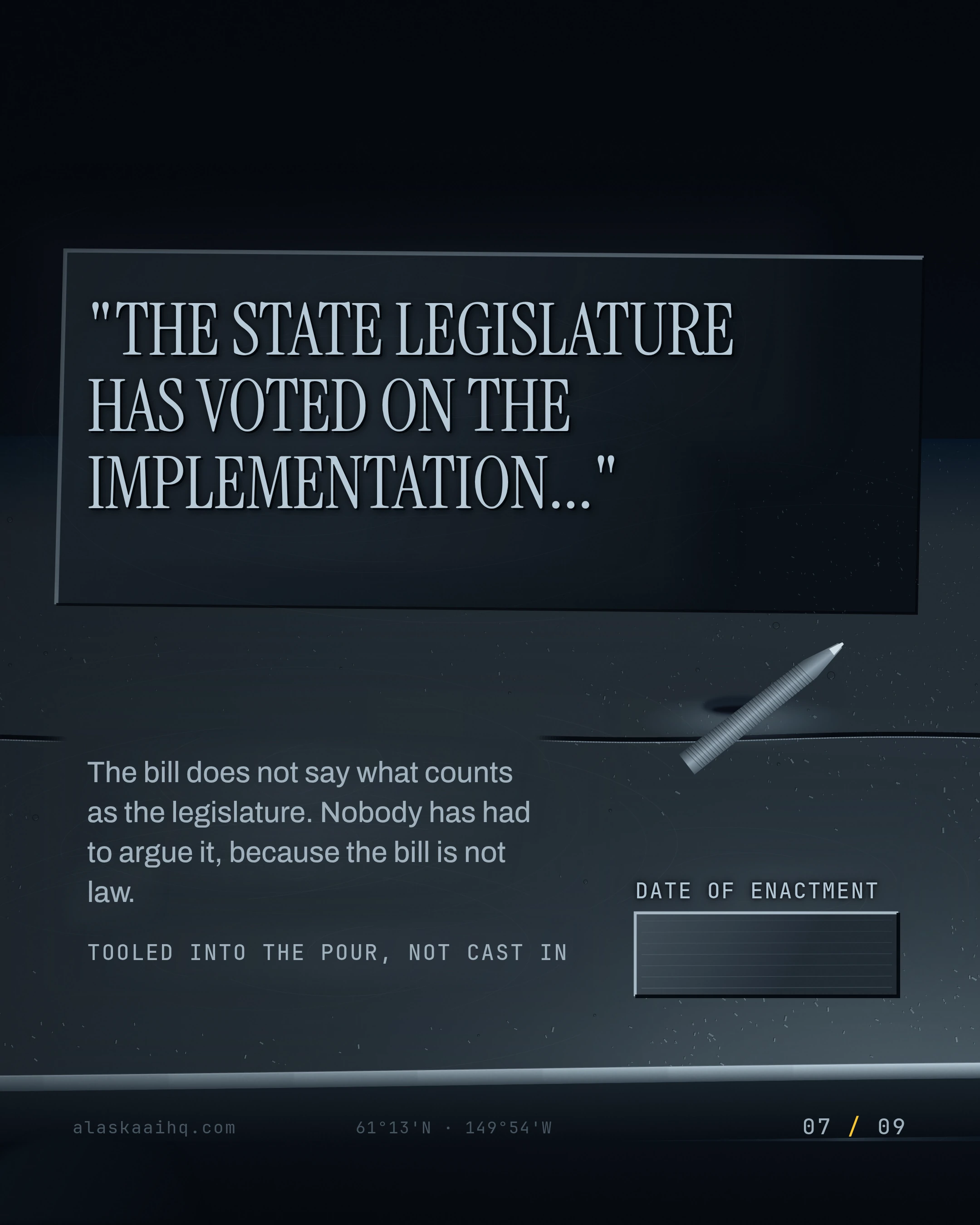
The third way a state qualifies for the H.R. 9340 exemption is that the state legislature has voted on implementation of the standard.
The House Committee on Energy and Commerce advanced the Ratepayer Protection Act by a vote of 52 to 0.
The Energy and Commerce committee vote on H.R. 9340 is reported by the committee under a July 21st, 2026 post.
Energy and Commerce Chairman Brett Guthrie said the Ratepayer Protection Act will ensure that data centers pay their own way instead of passing costs onto hardworking families.
H.R. 9340 does not appear on the published House floor schedule at docs.house.gov as read on September 13th, 2026.
H.R. 9340 does not appear on the House majority leader's published schedule as read on September 13th, 2026.
The White House says 23 governors signed the Ratepayer Protection Pledge.
The White House says more than 300 organizations committed to the Ratepayer Protection Pledge.
The Ratepayer Protection Pledge asks signers to build, bring or buy every kilowatt their facilities need.
The Department of Transportation request for information on America's Great Corridors of Commerce carries docket number DOT-OST-2026-3269.
Comments on the Department of Transportation corridors request for information are due by October 2nd, 2026.
The Department of Transportation corridors notice says an aim is to incentivize data centers to locate close to the corridors for easy connectivity.
The word Alaska does not appear in the Department of Transportation corridors request for information.
The Department of Energy request for information on securing the bulk-power system carries docket number DOE-HQ-2026-1123.
Responses to the Department of Energy bulk-power system request for information are accepted on or before October 9th, 2026.
The Department of Energy notice says growth in advanced manufacturing, data centers, artificial intelligence and defense production has increased the nation's dependence on abundant, reliable electricity.
The Department of Energy will hold a public webinar on the bulk-power system request for information on September 16th, 2026.
The DeepGreen Cook Inlet preliminary permit application is docketed at the Federal Energy Regulatory Commission as Project No. 15423-000.
Comments, motions to intervene and competing applications on the DeepGreen Cook Inlet permit are due by 5:00 p.m. Eastern Time on November 2nd, 2026.
KTOO's Gavel Alaska archive lists SB 250 as data centers and utilities business in both a Senate floor session and the House Community and Regional Affairs Committee.
The official title of Alaska Senate Bill 250 is An Act relating to data centers and relating to utility service for data centers.
Alaska Senate Bill 250 was sponsored by Sen. Loki Tobin.
Alaska Senate Bill 250 passed the Alaska Senate on May 16th, 2026.
BillTrack50 records Alaska Senate Bill 250 as having crossed over on May 16th, 2026.
After Senate passage SB 250 was referred to the House Community and Regional Affairs Committee where it died.
SB 250 would have required electric and gas utilities to enter commission-approved contracts with data center customers so that costs attributable to those facilities are borne by the operators rather than shifted to other customers.
SB 250 included reliability safeguards meant to prevent data center demand from adversely affecting fuel supplies or utility service for existing customers.
Committee amendments to SB 250 would have required data centers to provide financial security where serving them made a utility incur capital investment costs above 1 million dollars.
The last recorded action on SB 250 was a House Community and Regional Affairs Committee hearing on May 18th, 2026.
BillTrack50 lists SB 250 with a status of dead as of May 20th, 2026.
Neither available record shows the Alaska House ever taking a floor vote on SB 250.
Beats
This article is on Alaska data centers · Alaska power and the grid · Defense and federal AI in Alaska · Alaska AI policy and legislation. Each beat page keeps every decision and every article on that subject in one place.