Three Yeas, Three Short, No Start Date
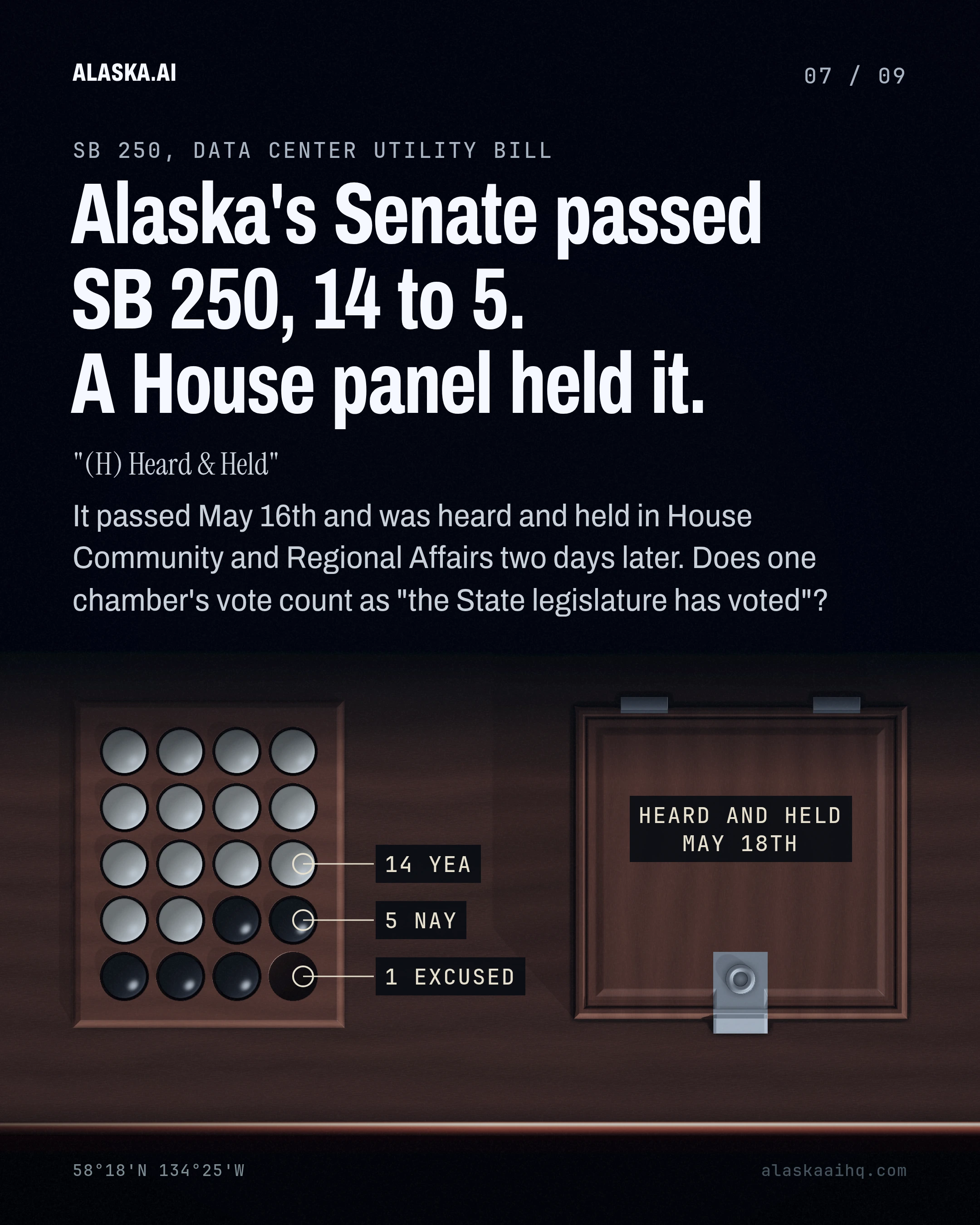
On the Alaska Senate floor in Juneau on May 16th, data center bill SB 250 passed 14 to 5.
The deck
SWIPE, SCROLL OR CLICK A SLIDE TO GO FULLSCREEN · 9 SLIDES


The story
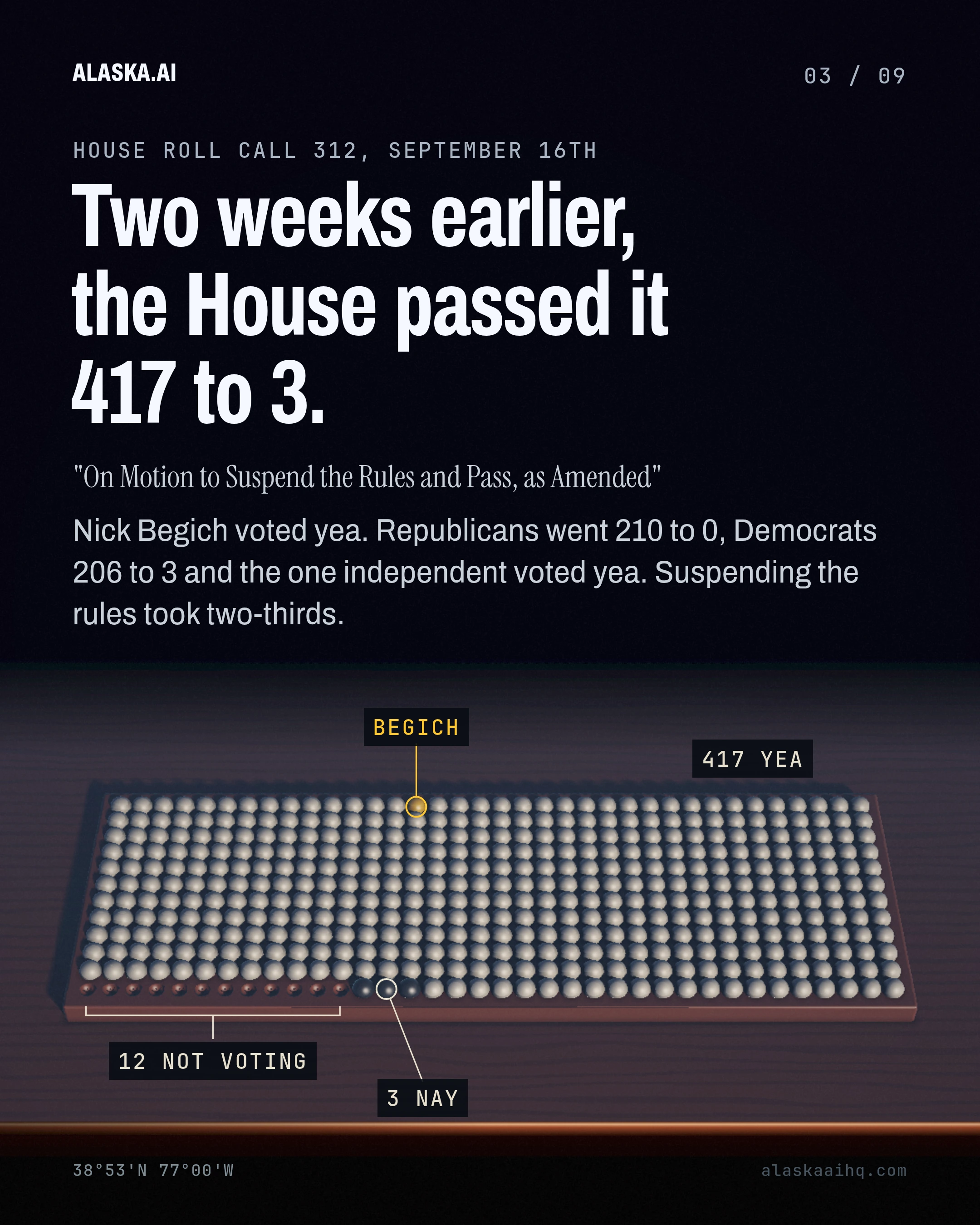
The U.S. House passed H.R. 9340, a grid cost standard for big computing sites, 417 to 3 on September 16th. Begich voted yea.
Alaska's House held SB 250 in committee on May 18th. It went no further.
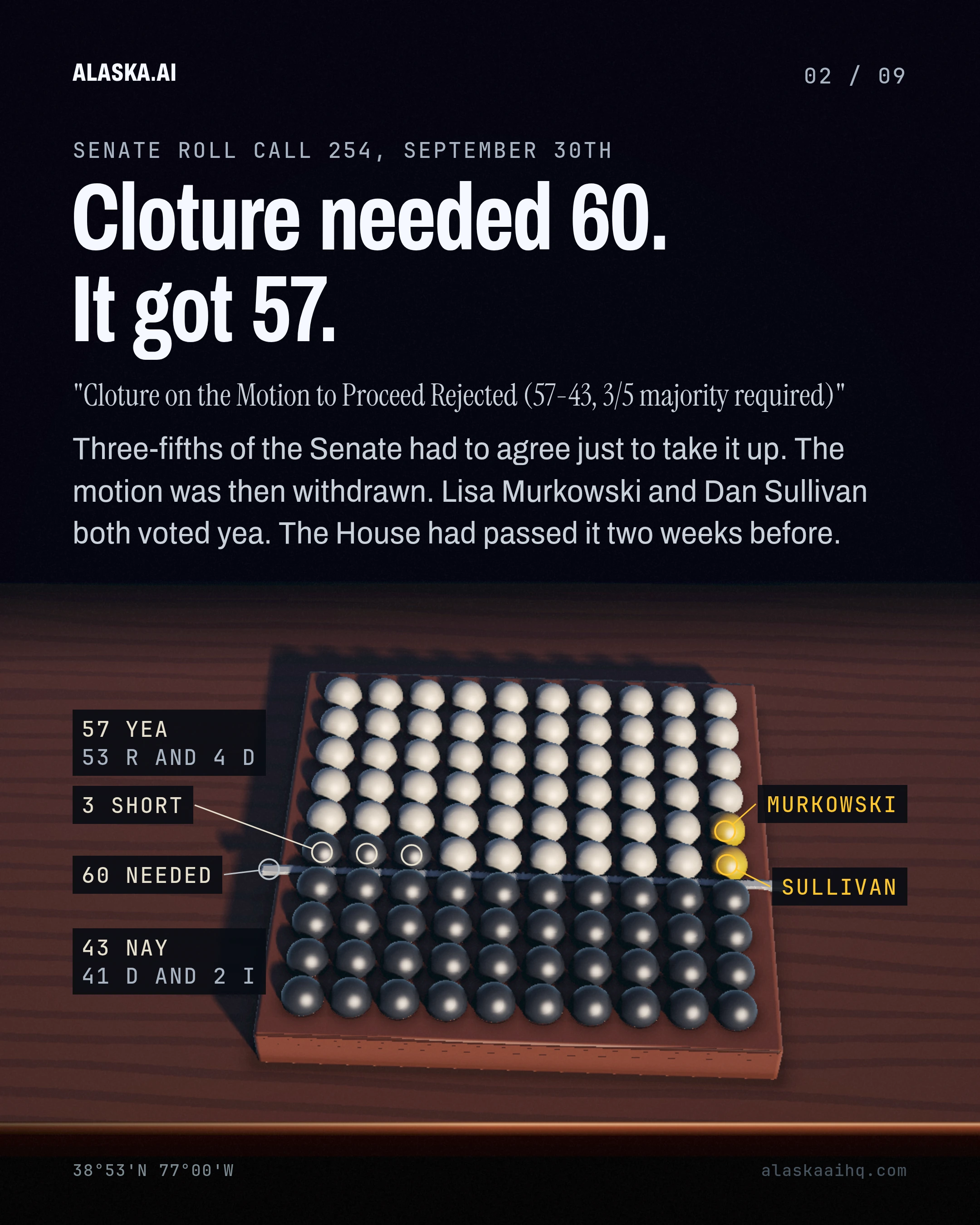
The U.S. Senate stopped at 57 on September 30th, with 60 needed for cloture. Murkowski and Sullivan voted yea.
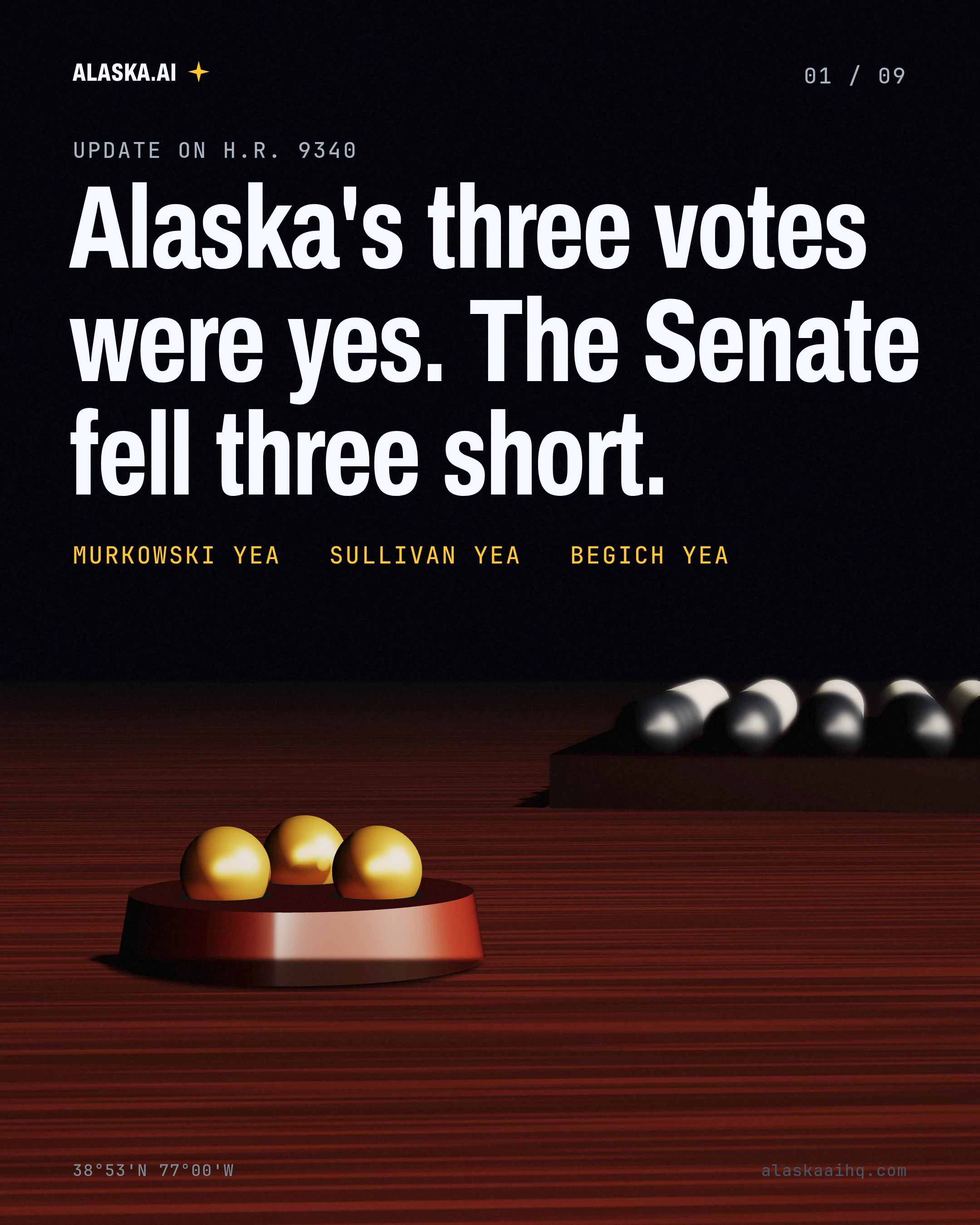
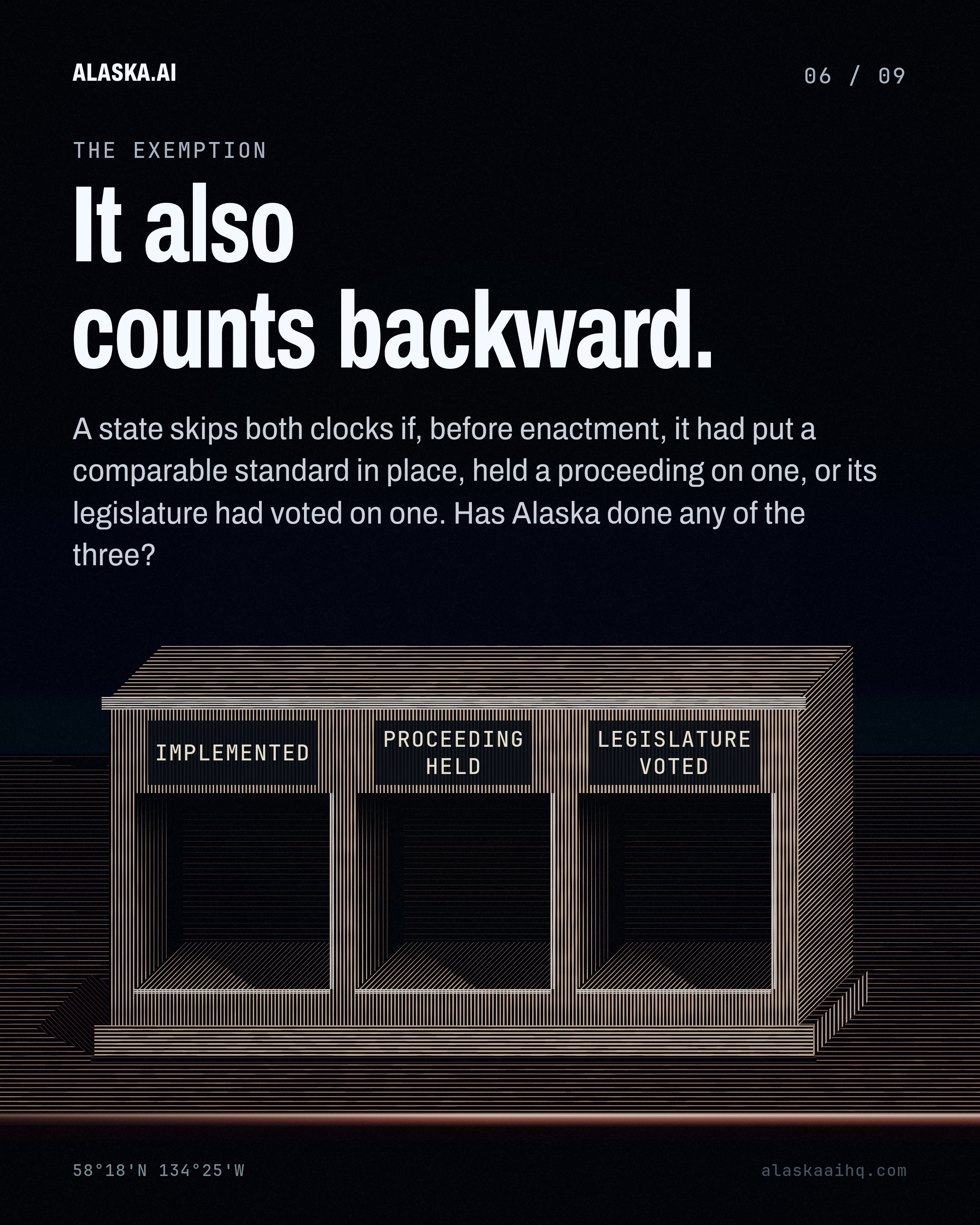
Gold marks Alaska's three yeas in a 100-cup Senate tray at 57 and a 432-cup House tray at 417, beside two unturned sand-glasses, a three-bay exemption cabinet, SB 250's 14 and 5 and a steel rule with no enactment tick.
Each bill cleared one chamber. H.R. 9340 would waive its review deadlines for a state whose legislature voted on a comparable standard before an enactment that hasn't happened.
Does "the State legislature has voted" mean both chambers?
What we verified
69 CLAIMS, EACH RE-FETCHED FROM ITS SOURCE BEFORE THIS DECK SHIPPED
The U.S. Senate voted on cloture on the motion to proceed to H.R. 9340 on September 30th.
The Senate recorded the H.R. 9340 cloture vote as record vote number 254.
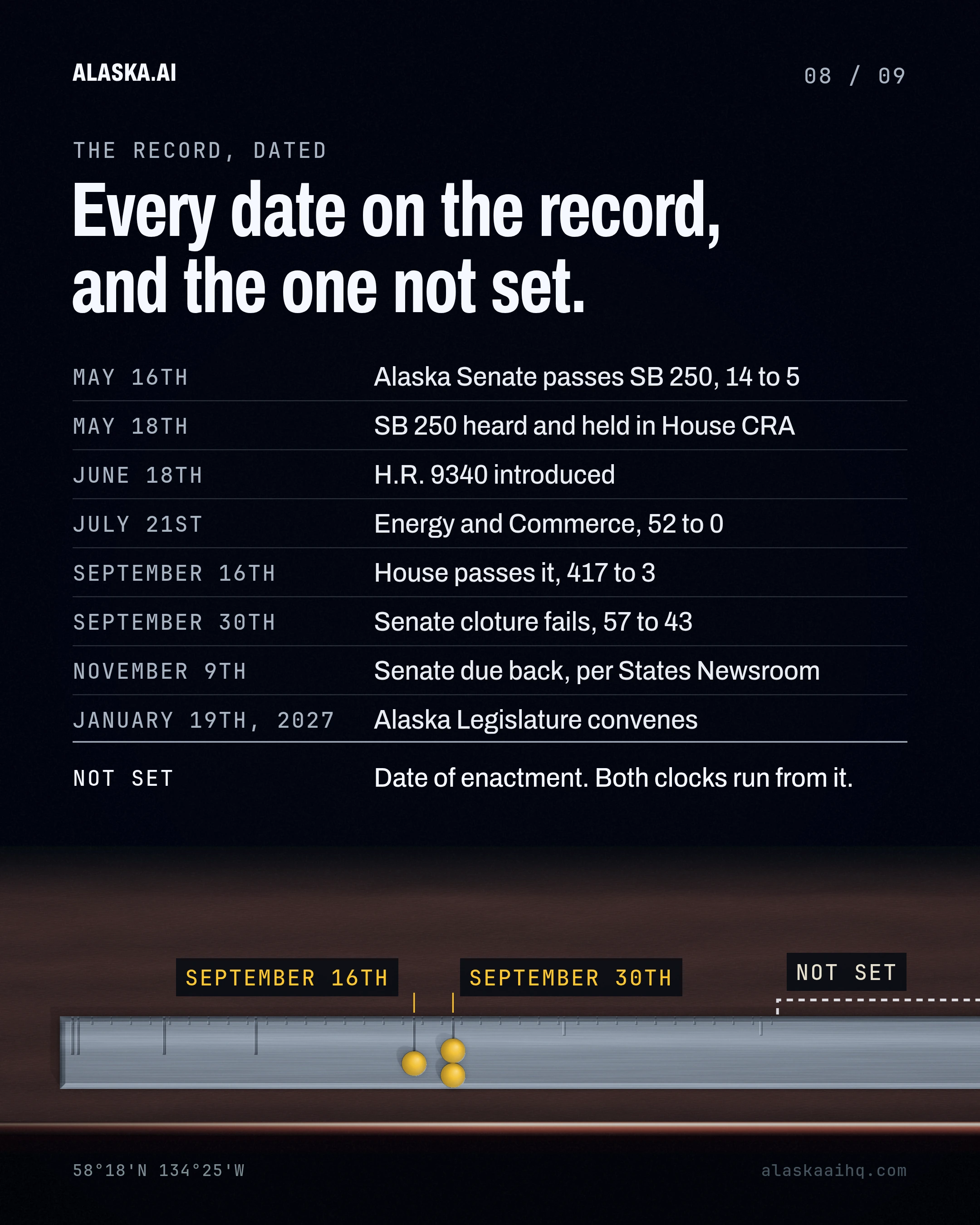
Cloture on the motion to proceed to H.R. 9340 was rejected 57 to 43.
The cloture vote on H.R. 9340 required a three-fifths majority.
Three-fifths of the 100-seat Senate is 60 votes.
With 57 yeas the cloture motion on H.R. 9340 fell three votes short of 60.
The Senate roll call record lists vote 254 at 12:51 p.m. on September 30th.
Sen. Lisa Murkowski (R-AK) voted yea on cloture on H.R. 9340.
Sen. Dan Sullivan (R-AK) voted yea on cloture on H.R. 9340.
All 53 Senate Republicans voted yea on cloture on H.R. 9340, and no Republican voted nay.
Sen. Maggie Hassan (D-NH) voted yea on cloture on H.R. 9340.
Sen. Amy Klobuchar (D-MN) voted yea on cloture on H.R. 9340.
Sen. Jon Ossoff (D-GA) voted yea on cloture on H.R. 9340.
Sen. Raphael Warnock (D-GA) voted yea on cloture on H.R. 9340.
Four Senate Democrats voted yea on cloture on H.R. 9340.
41 Senate Democrats voted nay on cloture on H.R. 9340.
Both independent senators, Angus King of Maine and Bernie Sanders of Vermont, voted nay on cloture on H.R. 9340.
After cloture failed, the motion to proceed to H.R. 9340 was withdrawn in the Senate on September 30th.
The House passed H.R. 9340 on September 16th.
The House vote on H.R. 9340 was taken at 6:53 p.m.
The House vote on H.R. 9340 was roll call 312.
The House took up H.R. 9340 on a motion to suspend the rules and pass the bill as amended.
Passage of H.R. 9340 under suspension required a two-thirds vote.
H.R. 9340 received 417 yea votes in the House.
H.R. 9340 drew 3 nay votes in the House.
Twelve House members did not vote on H.R. 9340.
Rep. Lee (D-PA) voted nay on H.R. 9340.
Rep. Ramirez (D-IL) voted nay on H.R. 9340.
Rep. Tlaib (D-MI) voted nay on H.R. 9340.
Rep. Nick Begich (R-AK) voted yea on H.R. 9340.
House Republicans voted 210 to 0 for H.R. 9340.
House Democrats voted 206 to 3 for H.R. 9340.
The one independent House member voted yea on H.R. 9340.
H.R. 9340 is sponsored by Rep. Gabe Evans, a Colorado Republican from the 8th District.
H.R. 9340 was introduced in the House on June 18th.
The House Energy and Commerce Committee ordered H.R. 9340 reported 52 to 0 on July 21st.
Energy and Commerce reported H.R. 9340 to the House on September 10th as House Report 119-814.
H.R. 9340 was received in the Senate on September 17th.
H.R. 9340 was placed on the Senate Legislative Calendar as Calendar No. 684 on September 24th.
A cloture motion on the motion to proceed to H.R. 9340 was presented in the Senate on September 28th.
H.R. 9340 defines a large-load customer by facilities that require electric energy primarily to operate information technology infrastructure for data storage and computational applications.
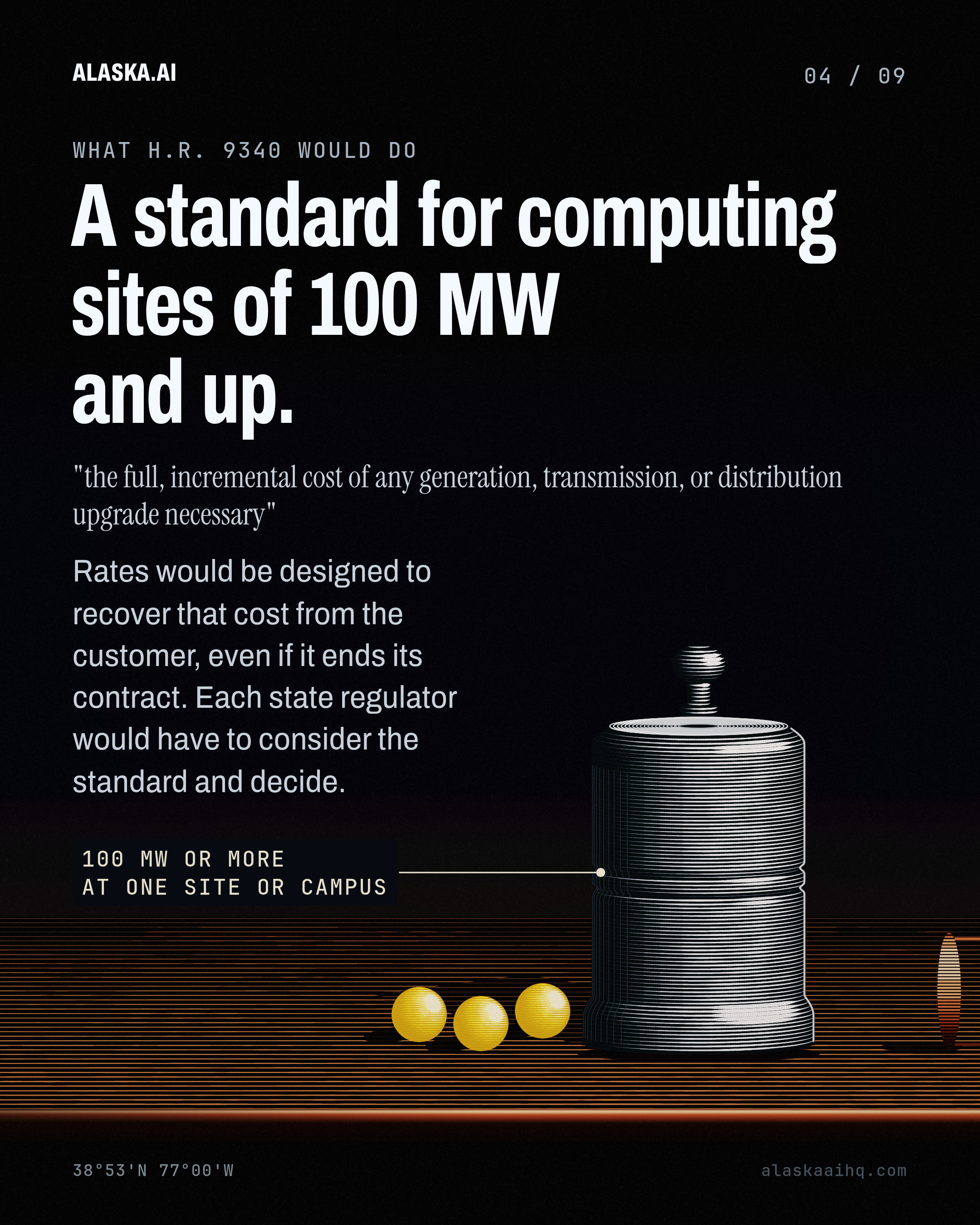
Under H.R. 9340 the large-load threshold is an aggregate peak demand of 100 megawatts or more at a single site or campus.
H.R. 9340 applies the large-load definition only to non-residential consumers who request or enter a contract on or after enactment.
H.R. 9340 says rates to a large-load customer shall be designed to recover the full, incremental cost of any generation, transmission or distribution upgrade needed to serve it.
The H.R. 9340 cost recovery standard covers the case of a large-load customer terminating its contract or ceasing to buy power.
Under the H.R. 9340 standard a utility must require financial assurances or contributions from a large-load customer before making an upgrade to serve it.
H.R. 9340 gives each State regulatory authority 1 year after enactment to commence consideration of the standard or set a hearing date.
H.R. 9340 gives each State regulatory authority 2 years after enactment to complete consideration and make a determination on the standard.
H.R. 9340 exempts a state from the consideration clocks if, before enactment, the state has implemented the standard or a comparable standard.
H.R. 9340 also exempts a state whose regulatory authority has conducted a proceeding to consider implementing the standard before enactment.
H.R. 9340 also exempts a state where the state legislature has voted on implementing the standard or a comparable one before enactment.
In floor remarks on September 29th, Schumer said that all Republicans offer on AI and data centers is a toothless messaging bill.
A Senate bill also titled the Ratepayer Protection Act, S. 5028, was introduced by Sen. Jon Husted of Ohio on July 16th.
The Alaska Senate passed CSSB 250(CRA) on May 16th.
The final Alaska Senate vote on SB 250 was 14 to 5 with one member excused.
Before reconsideration the Alaska Senate first passed SB 250 by 13 to 5 with two excused on May 16th.
The Alaska House Community and Regional Affairs Committee heard and held SB 250 on May 18th, its last recorded action.
Alaska law empowers the Regulatory Commission of Alaska to regulate every public utility doing utility business in the state.
Alaska law empowers the Regulatory Commission of Alaska to make or require just, fair and reasonable rates for a public utility.
Alaska law sets the Legislature to convene at the capital each year on the third Tuesday in January at 1 p.m.
The third Tuesday in January 2027 falls on January 19th, 2027, the statutory convening date of the next Alaska Legislature.
Alaska's general election falls on Tuesday, November 3rd.
U.S. senators left the Capitol on the night of Wednesday, September 30th, for their campaign break.
States Newsroom reported that the Senate won't return until November 9th.
States Newsroom described the coming lame-duck session as five weeks long.
States Newsroom listed unrestrained development of artificial intelligence among the frustrations behind Democrats' growing midterm optimism.
Al Jazeera reported that Senate Democratic leader Chuck Schumer dismissed the legislation as "toothless".
Alaska SB 250 was sponsored by Sen. Loki Tobin, a Democrat.
The title of Alaska SB 250 is An Act relating to data centers and relating to utility service for data centers.
Beats
This article is on Alaska data centers · Alaska power and the grid · Defense and federal AI in Alaska · Alaska AI policy and legislation. Each beat page keeps every decision and every article on that subject in one place.