AIDEA's Fiber Tool and NuCube Stake, Cut Open
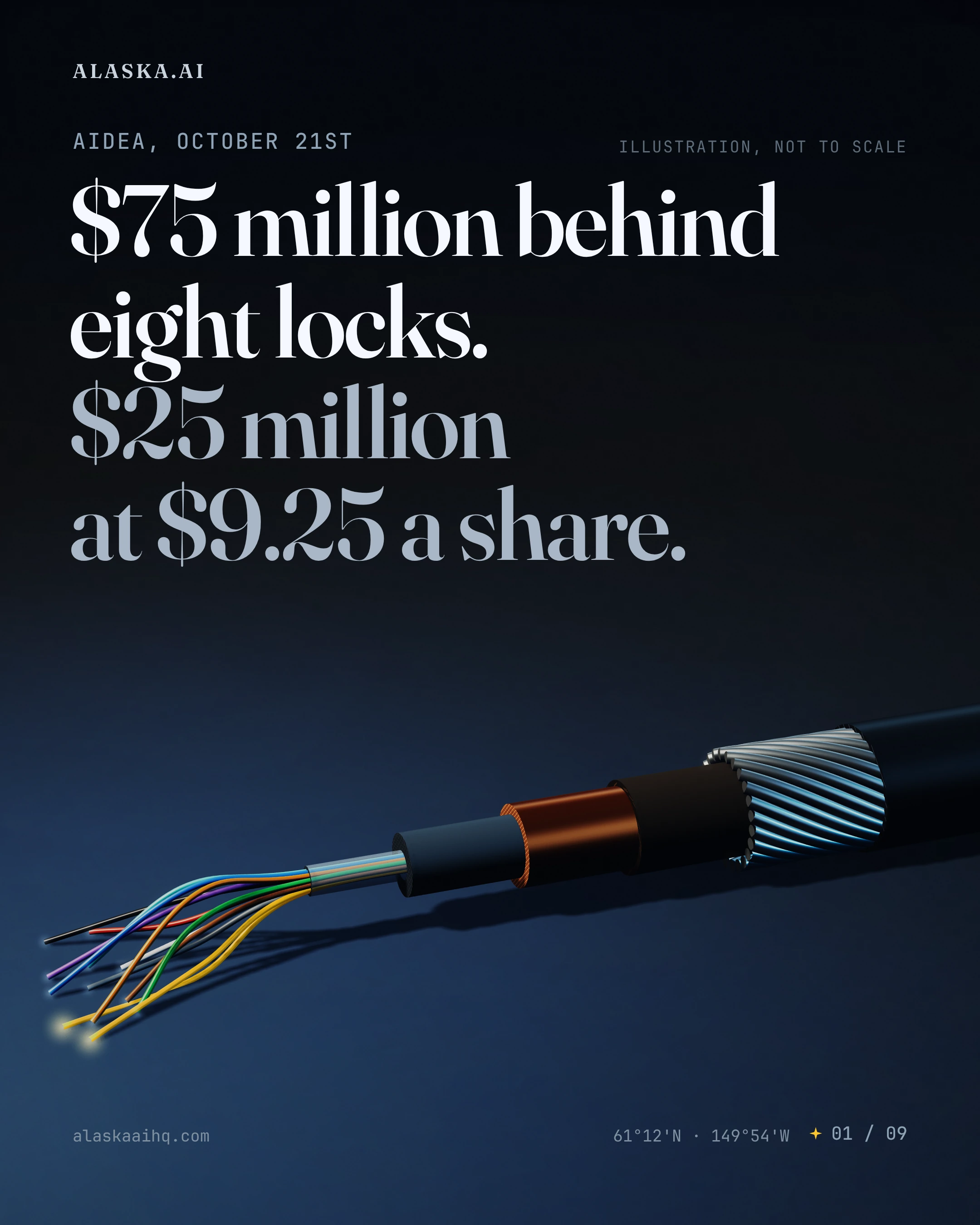
AIDEA called two very different things an "investment" on October 21st.
The deck
SWIPE, SCROLL OR CLICK A SLIDE TO GO FULLSCREEN · 9 SLIDES



The story
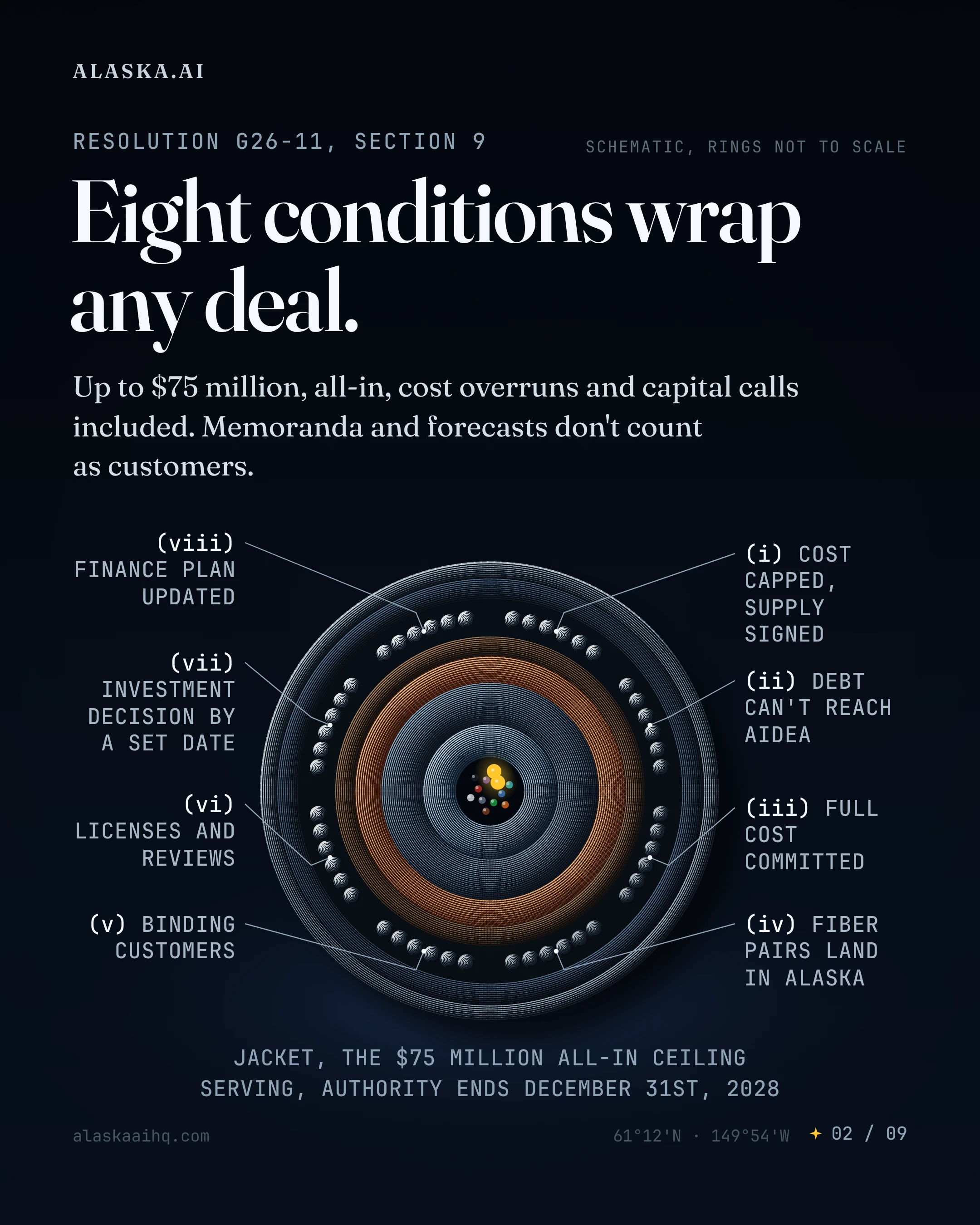
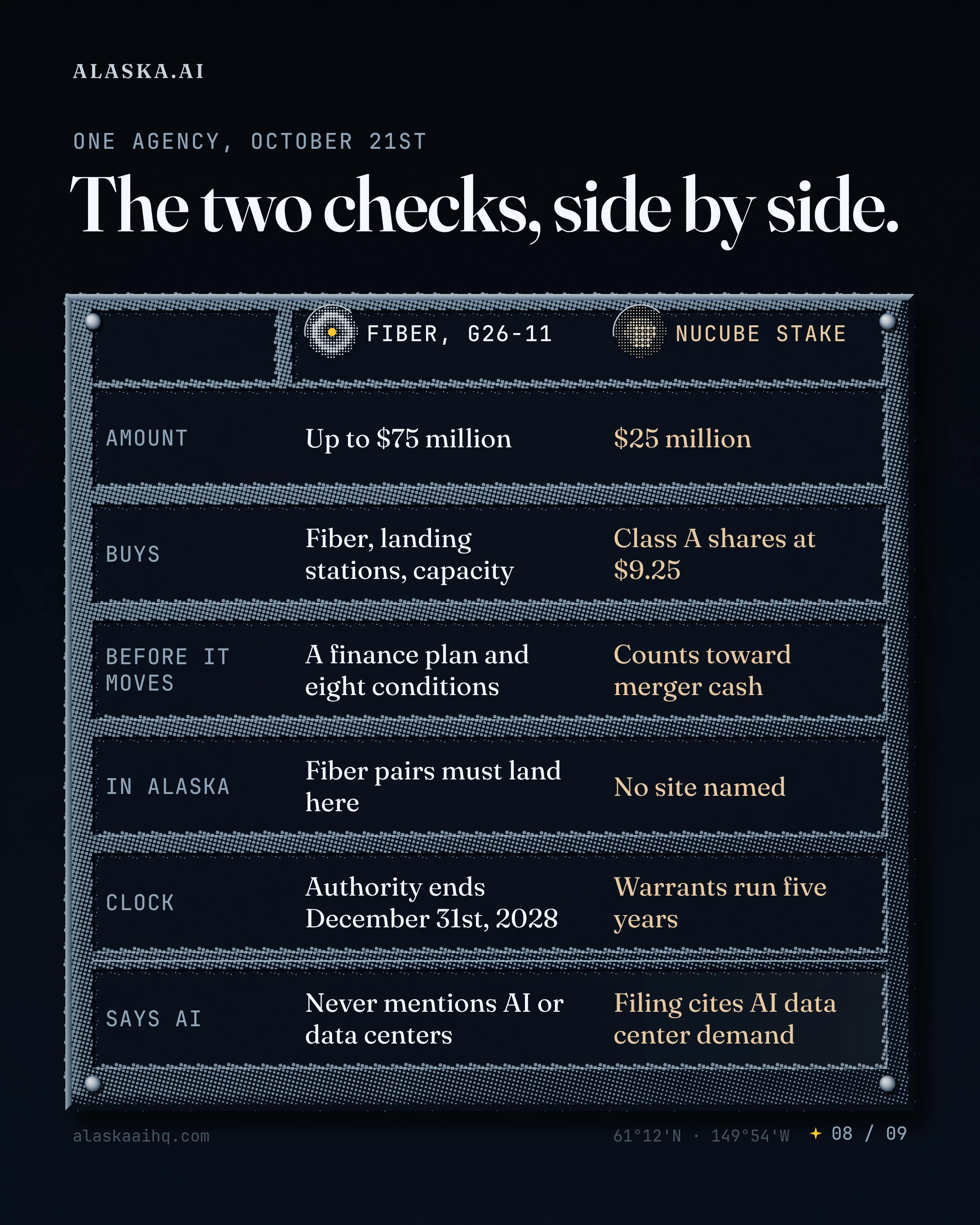
What does it mean for fiber? Up to $75 million all-in. Any binding deal carries at least eight conditions. Fiber pairs must land in Alaska. Signing authority ends December 31st, 2028 unless extended.
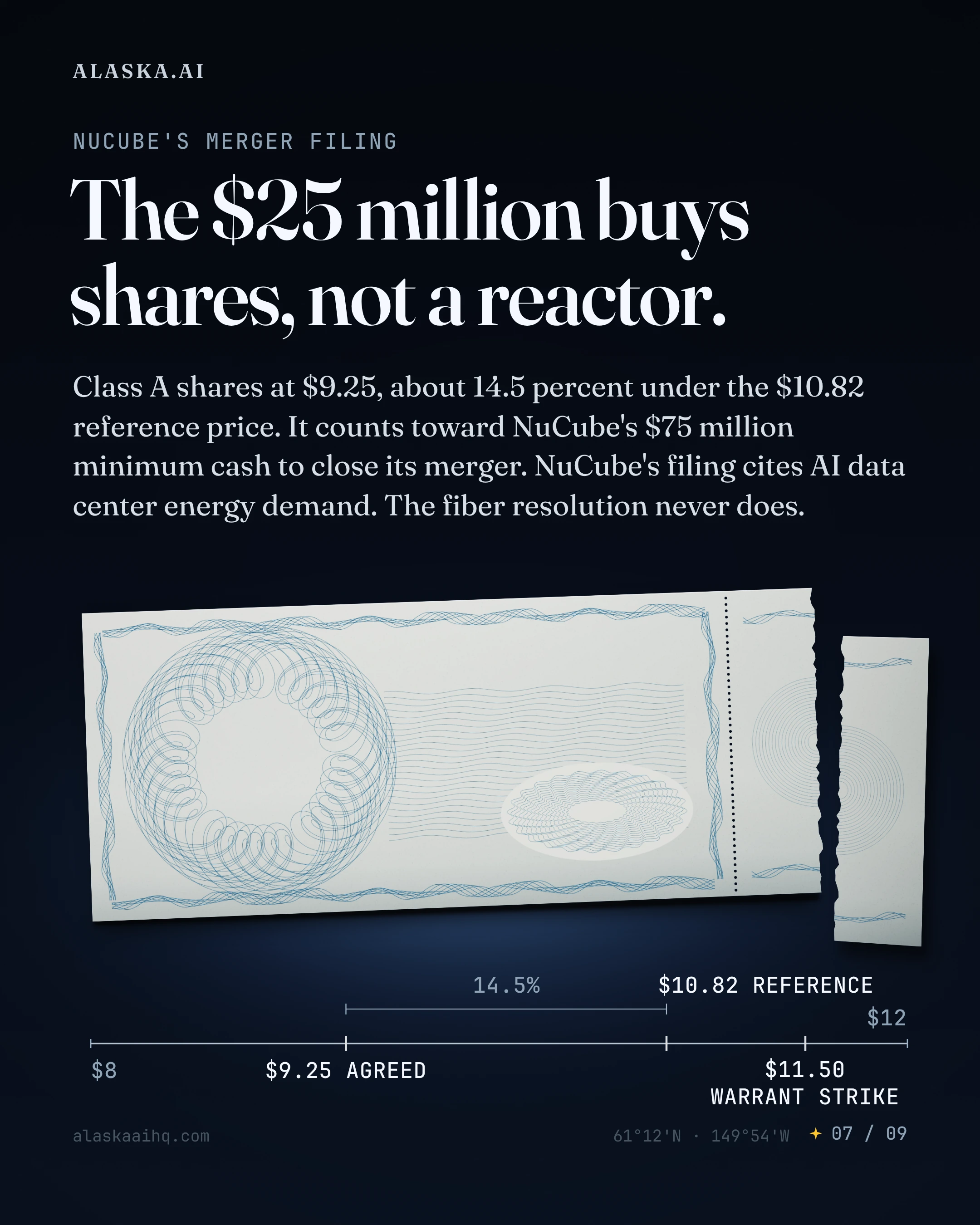
What does it mean for NuCube? $25 million in shares at $9.25, with half a warrant each at $11.50. The stake counts toward a different $75 million, NuCube's merger cash condition. No Alaska site, utility, customer or date is named.
Where does AI come in? The fiber resolution never mentions AI or data centers. NuCube's filing cites AI data center energy demand.
Eight conditions drawn as cable armor, four subsea cables by age, a NuCube price ladder and both checks side by side.
Should the rule that makes fiber land here also make the next equity stake name an Alaska site?
What we verified
108 CLAIMS, EACH RE-FETCHED FROM ITS SOURCE BEFORE THIS DECK SHIPPED
The AIDEA board voted unanimously on October 21st to adopt Resolution G26-11.
Resolution G26-11 creates Northstar Fiber Development LLC as a wholly owned AIDEA subsidiary with AIDEA as its sole member.
Resolution G26-11 caps the subsidiary's capitalization at $75 million.
The resolution authorizes moving up to $75 million out of AIDEA's Revolving Fund to the subsidiary.
Transfers under the resolution are staged, and until a qualifying investment is approved they are limited to formation, operating and professional services costs.
The $75 million is the aggregate ceiling for all transfers and commitments under the resolution and is not additive.
The resolution treats $75 million as AIDEA's maximum direct and indirect exposure, including capital calls and cost overruns.
Any commitment must state that AIDEA and the subsidiary have no obligation to fund beyond the committed amount.
Raising the ceiling or giving any guarantee or debt support requires further board approval.
The authorized investments cover subsea and terrestrial fiber systems, landing stations, backbone and middle-mile networks, and associated capacity.
Before any approval or commitment, the executive director must obtain due diligence sized to the investment's size and risk.
Before any approval or commitment, the executive director must make a written determination that the investment is in the public interest and consistent with the resolution.
Before any approval or commitment, tax counsel must review the entity and tax structure, including federal, Alaska, foreign and withholding taxes.
Before any approval or commitment, the chief financial officer, advised by bond counsel, must confirm the investment won't impair AIDEA's bond covenants, pledged revenues, liquidity or custody protections.
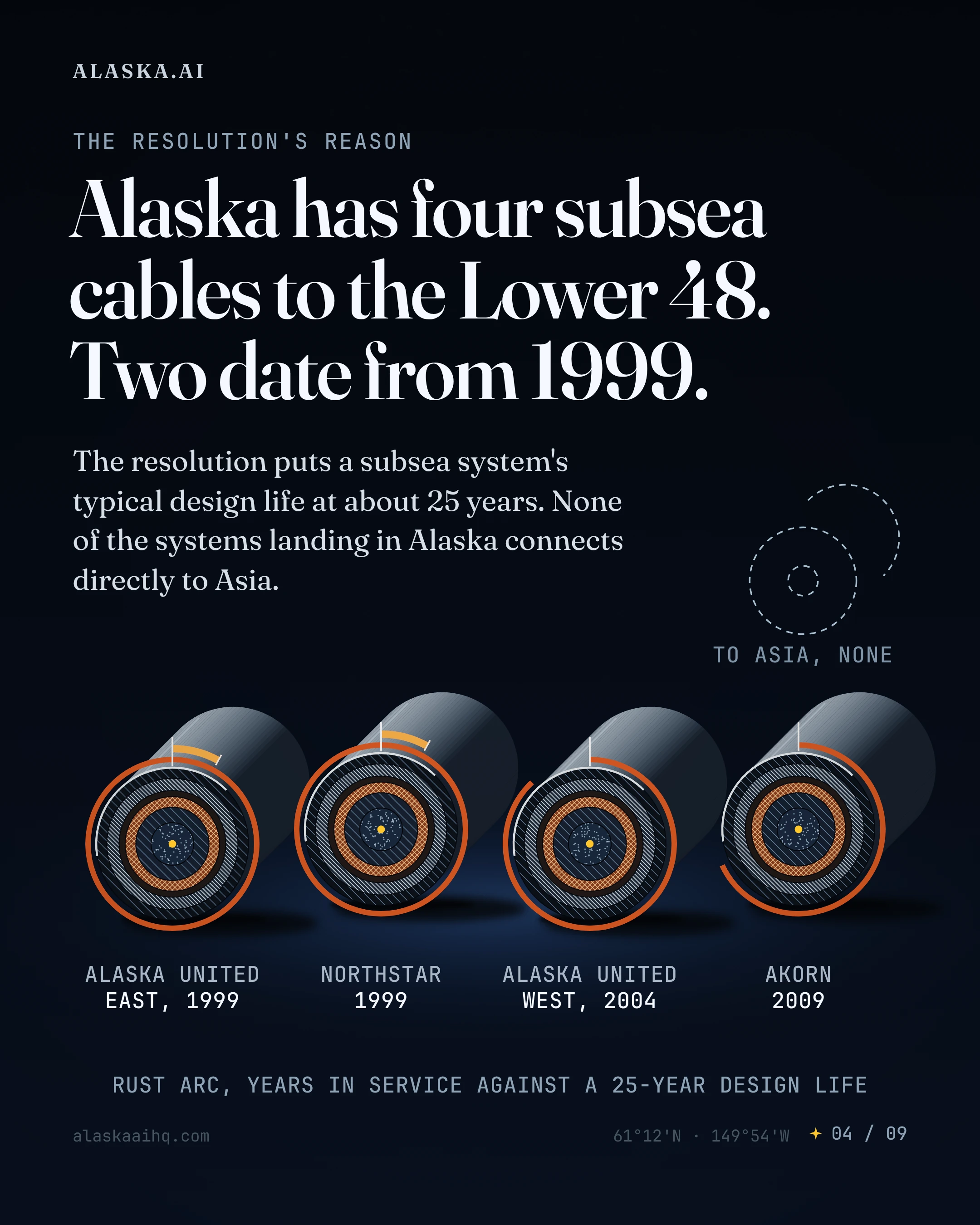
The resolution lists Alaska United East as entering service in 1999.
The resolution lists NorthStar as entering service in 1999.
The resolution lists Alaska United West as entering service in 2004.
The resolution lists the ACS Alaska Oregon Network, AKORN, as entering service in 2009.
The resolution states that no entity it references has approved, sponsored, offered or committed to any project.
The subsidiary may hold equity-only stakes without responsibility for building or operating the infrastructure.
The resolution sets the subsidiary's initial priority as improving Pacific fiber connectivity with Alaska.
The resolution says the subsidiary's initial focus is moving Alaska from a data cul-de-sac toward becoming a data hub.
The resolution directs the subsidiary to explore and collaborate on trans-Pacific connectivity with Asia.
The resolution bars any deal involving a party on a US State Department or other federal restricted list.
The resolution does not by itself approve any specific project, route, party or transaction.
Before approving a project or signing a binding commitment, the executive director must have a finance plan prepared under AS 44.88.173 and 3 AAC 99.510.
The executive director must sign a written certification that the finance plan is complete and that the Section 9 conditions are met.
Before any commitment the executive director must get written confirmation from external counsel that the investment is within AIDEA's statutory authority.
Any investment must provide fiber pairs or capacity that physically land in and are available for use in Alaska.
External counsel must screen every participant and its beneficial owners against the restricted lists, and redo the screen before each funding.
Under the resolution, memoranda of understanding, expressions of interest and forecasts don't count toward the required binding customer commitments.
Any binding commitment must keep project-level debt without recourse to AIDEA or the subsidiary.
AIDEA's funding obligation ends if the project sponsor misses an agreed outside date for its final investment decision.
The executive director must report to the AIDEA board monthly on the subsidiary's activities.
The executive director's power to approve projects and sign binding commitments under the resolution expires on December 31st, 2028 unless the board extends it.
Citing TeleGeography, the resolution says only four subsea systems connect Alaska to the contiguous United States.
The resolution says Alaska United East and NorthStar entered service in 1999 and have reached the end of their typical design life.
The resolution puts the typical design life of subsea fiber systems at about 25 years.
AIDEA's release describes Alaska as a digital cul-de-sac where traffic must travel through the Lower 48 to reach the rest of the world.
The resolution says MTA's AlCan ONE, Alaska's single all-terrestrial fiber route through Canada, was completed in 2020.
The resolution says none of the subsea systems landing in Alaska connects Alaska directly to Asia.
The resolution states that Alaska was allocated $1,017,139,672.42 under the federal BEAD broadband program.
AIDEA says $629 million of Alaska's BEAD money has been awarded to 15 providers for 29 projects.
AIDEA says the awarded BEAD projects will bring high-speed internet to more than 46,000 Alaska homes and small businesses.
AIDEA says roughly 70 percent of BEAD locations are expected to be connected by 2028.
Citing an ITU advisory body, the resolution says submarine cables carry over 99 percent of intercontinental data traffic.
The resolution says submarine cables suffer about 150 to 200 faults a year.
The resolution cites a TeleGeography forecast of more than 1,010,000 kilometers of new submarine cable deployed worldwide from 2026 to 2035.
The same TeleGeography forecast, as cited in the resolution, says more than 450,000 kilometers of older cable may be retired over that period.
The resolution says Ted Stevens Anchorage International Airport handled 3,854,614 metric tonnes of cargo in 2025, according to Airports Council International World.
The resolution says aircraft from Anchorage can reach nearly 90 percent of the industrialized world within a single 9.5-hour flight.
The resolution acknowledges that the Copenhagen Economics analyses it cites have not quantified impacts specific to Alaska.
The text of Resolution G26-11 does not mention artificial intelligence or data centers.
AIDEA's October 23rd release on the fiber resolution does not mention artificial intelligence or data centers.
AIDEA board chair Bill Kendig called the resolution a disciplined tool with clear limits and strong board oversight.
AIDEA executive director Randy Ruaro said the routes chosen in the next few years will last for decades.
Governor Mike Dunleavy said Alaska has always been at the crossroads of the world.
Alaska Broadband Office director Thomas Lochner said the fiber investment helps keep the networks being built today fast, affordable and reliable for decades.
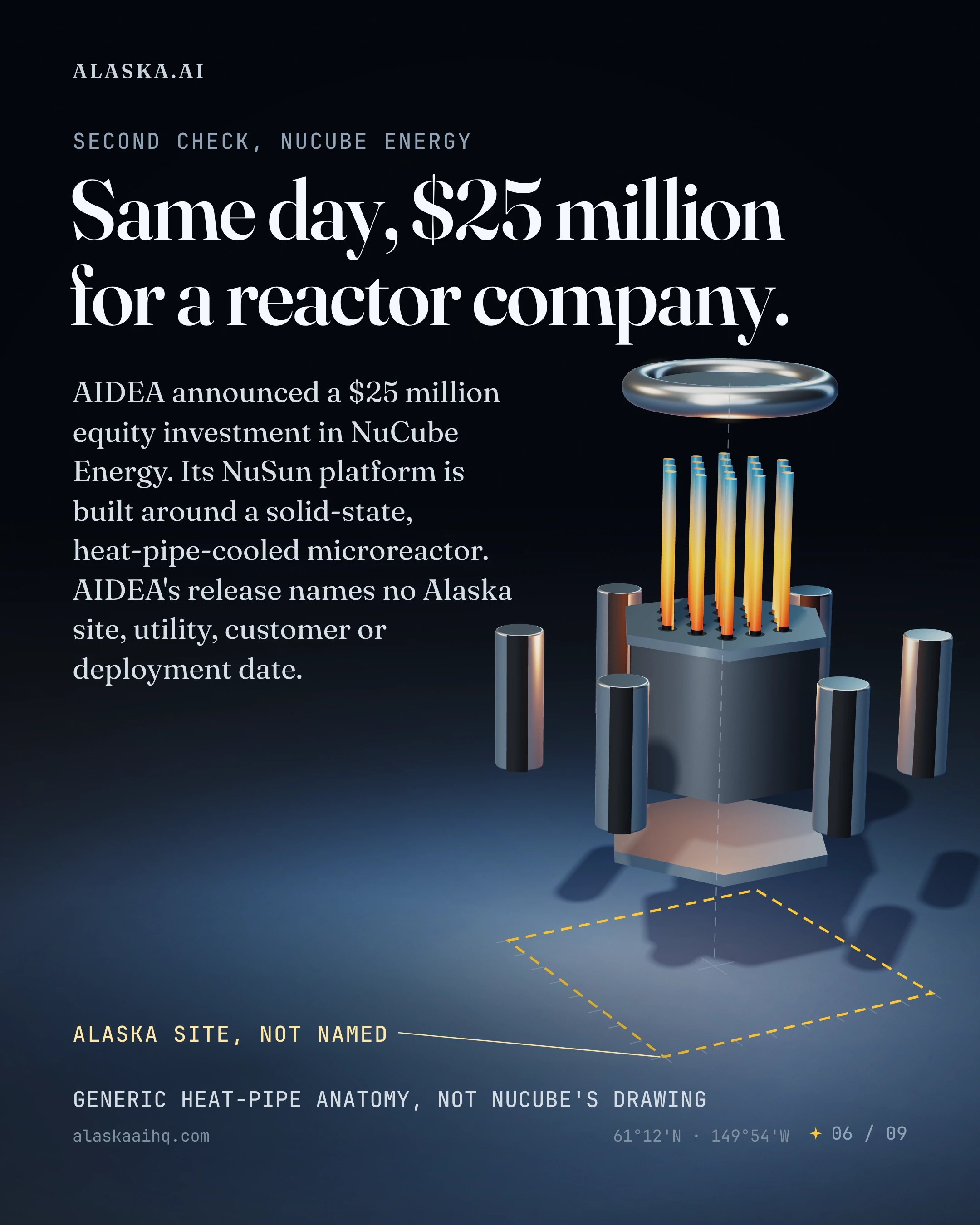
AIDEA announced a $25 million equity investment in NuCube Energy on October 21st.
AIDEA's NuCube release names data centers among the industries that cheaper, more dependable energy could help.
NuCube's NuSun platform is built around a solid-state, heat-pipe-cooled microreactor.
AIDEA's $25 million counts toward the $75 million minimum cash condition for closing NuCube's merger with Launch Two Acquisition Corp.
Under the NuCube filing, AIDEA agreed to buy $25 million of Class A ordinary shares at $9.25 per share.
NuCube's filing says the $9.25 price is an approximately 14.5 percent discount to the $10.82 reference price used for the merger exchange ratio.
Each share AIDEA buys comes with one-half of a warrant exercisable at $11.50 within five years.
NuCube's filing describes AIDEA as the anchor investor in the company's current financing.
NuCube's filing mentions AI data center energy demand in its forward-looking statements section.
NuCube was one of four companies selected for the Department of Energy's Nuclear Energy Launch Pad initiative on April 27th.
AIDEA's release names Arizona Nuclear Ventures, Emission Reduction Corporation, and Rob Walton and Jordan Rose Walton as other NuCube investors.
AIDEA's NuCube release says individual project costs and energy savings will be determined as projects are developed.
AIDEA's release says the benefits depend on technology development, regulatory approvals, project financing and work with prospective host communities.
AIDEA's NuCube release names no specific Alaska site, community, utility or customer and gives no deployment date.
AIDEA's board schedule lists its next meetings on November 4th and December 4th.
AIDEA's schedule page lists two resolutions for the October 21st meeting, G26-11 on fiber development and G26-12 on EDA grants.
DeepGreen's preliminary permit application describes about 330 to 350 marine hydrokinetic turbines.
The DeepGreen application describes 66 modular subsea compute hives, or data center pods.
The DeepGreen application describes an approximately 3.5-mile subsea power and fiber cable.
The DeepGreen cable is described as a 115 kV line.
The DeepGreen cable would land within the Nikiski Industrial Corridor.
FERC's notice puts the DeepGreen project's estimated annual generation at 100 megawatts.
Comments, motions to intervene and competing applications on the DeepGreen permit are due by 5 p.m. Eastern on November 2nd.
The DeepGreen application is FERC Project No. 15423.
Section 9 of Resolution G26-11 lists eight items, (a) through (h), that the executive director must obtain before approving a project or committing funds.
Any binding commitment under the resolution must make AIDEA's funding conditional on at least eight conditions, (i) through (viii).
A binding commitment must be conditional on total project cost, backed by executed supply arrangements, staying under an agreed maximum.
A binding commitment must be conditional on committed sources of money sufficient to pay total project cost.
A binding commitment must be conditional on a minimum number of fiber pairs, with defined capacity and access rights, physically landing in Alaska.
A binding commitment must be conditional on binding customer commitments that meet an agreed minimum threshold.
A binding commitment must be conditional on the required licenses and regulatory reviews.
A binding commitment must be conditional on an updated finance plan confirming the project remains within the agreed limits.
Before any approval or commitment, AIDEA's chief financial officer or a designee must confirm that funds are available and how they will be accounted for.
Columnist Dermot Cole wrote that the state provided no background research and no information about how NuCube was selected.
Kenai Peninsula Borough Mayor Peter Micciche called DeepGreen's approach sloppy.
Micciche says DeepGreen hasn't contacted him by email, letter or phone.
Kenai Peninsula Borough officials plan to push state lawmakers this session to craft formal oversight guidelines for emerging commercial technologies on public lands and waters.
In a FERC answer filed Tuesday, DeepGreen said the objections rest on a fundamental misconception.
DeepGreen told FERC that a preliminary permit doesn't authorize an applicant to disturb the seabed.
DeepGreen's Louis Wolfson wrote that contacting borough officials before knowing whether the engineering and biology work would be putting the cart before the horse.
KTUU reported NOAA's count of about 300 beluga whales living in the Cook Inlet area.
Anchorage Assembly member Sydney Scout said members spent three hours getting through about one and a half amendments.
The surveillance ordinance was discussed at the Anchorage Assembly's October 20th meeting, where members made little headway.
An effort to extend the Assembly meeting to keep discussing the surveillance proposal failed for lack of support.
Assembly members scrambled to wrap up the night's business by 11 p.m.
The surveillance ordinance is set to return on the Assembly's November 4th agenda.
The original surveillance ordinance was sponsored by Vice Chair Daniel Volland, Sydney Scout and Keith McCormick.
A substitute version from Mayor Suzanne LaFrance's administration is co-sponsored by Assembly members Yarrow Silvers and Jared Goecker.
Police Chief Sean Case argued the original version could hamper the department's ability to adapt to technologies like license plate readers and commercial AI products.
The proposal would codify surveillance restrictions in municipal code, including penalties if police violate them.
Beats
This article is on Alaska data centers · Alaska power and the grid · Alaska AI policy and legislation. Each beat page keeps every decision and every article on that subject in one place.