One Unit, Counted Up. Alaska's Data Center Scale Ladder
House District 9 runs from South Anchorage to Whittier. Its data center debate reaches a proposed lease 26 miles south of Deadhorse.
The deck
SWIPE, SCROLL OR CLICK A SLIDE TO GO FULLSCREEN · 10 SLIDES



The story
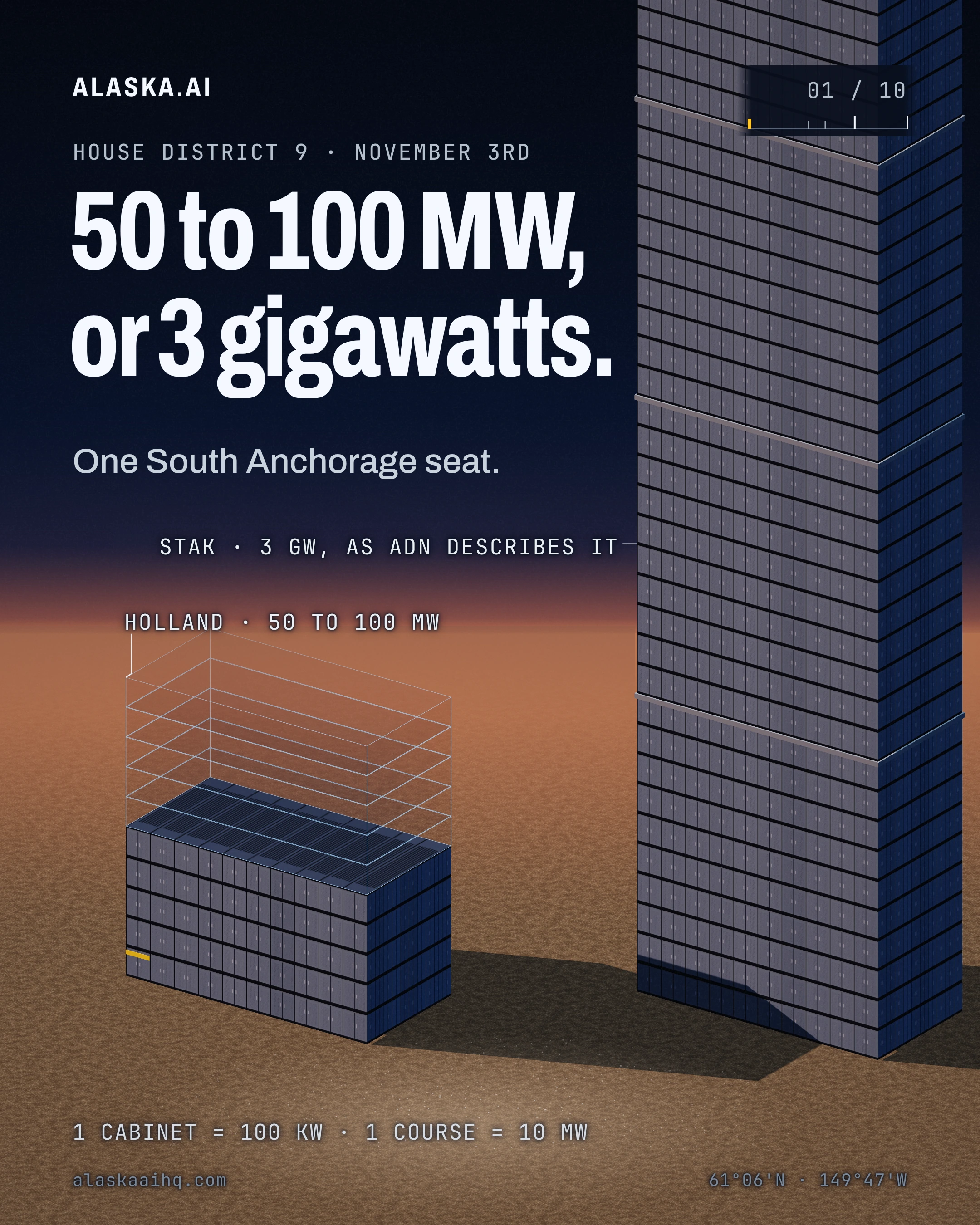
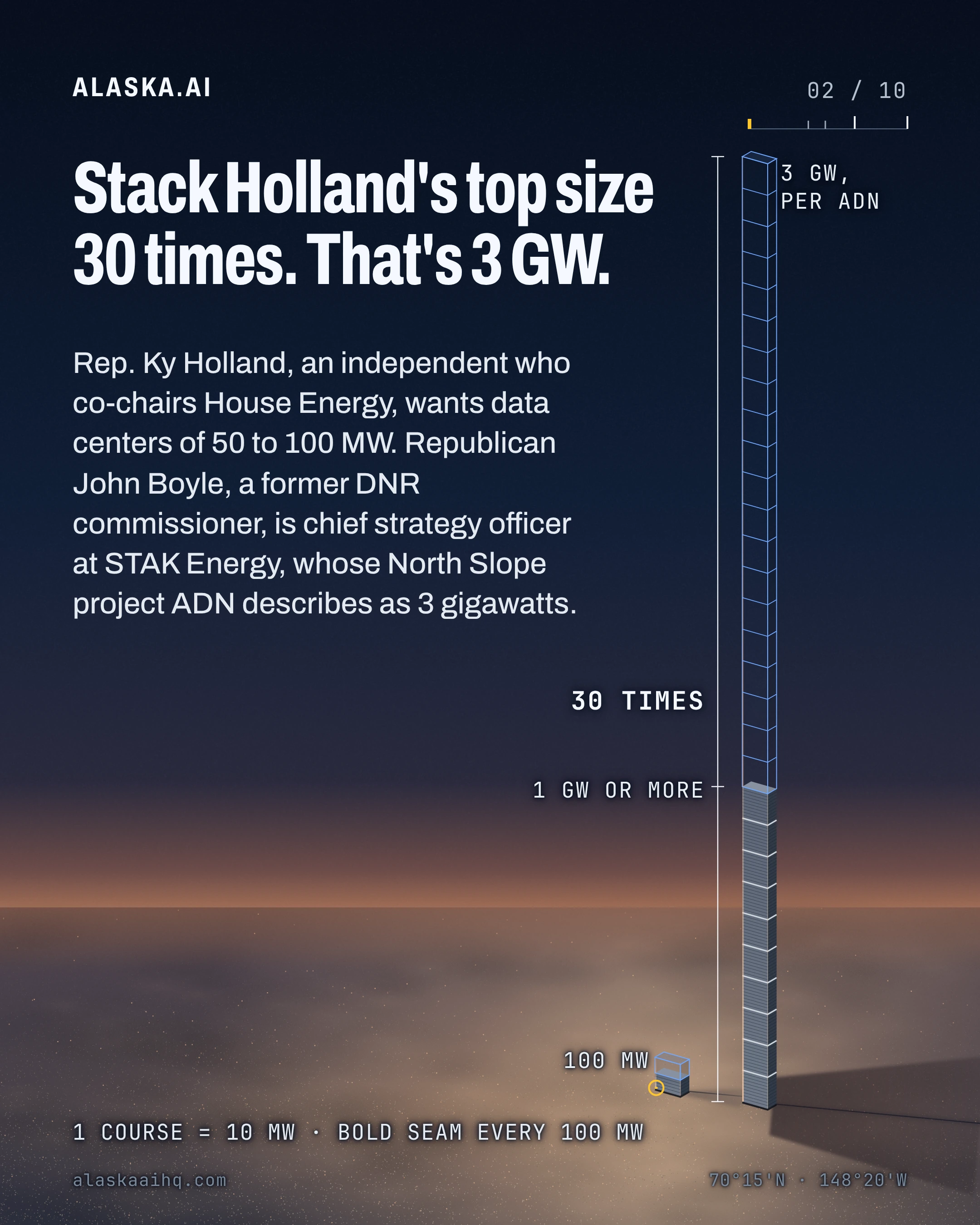
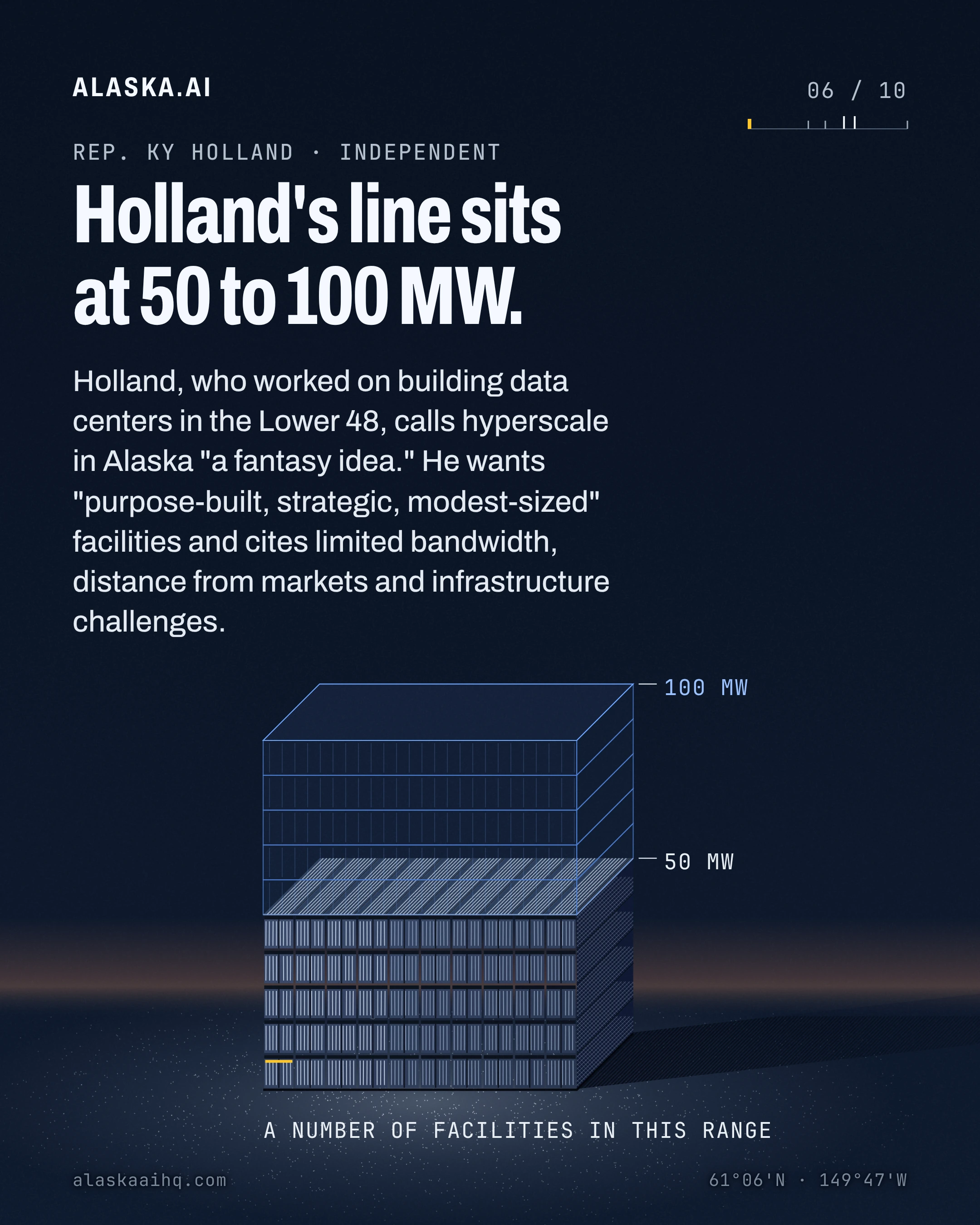
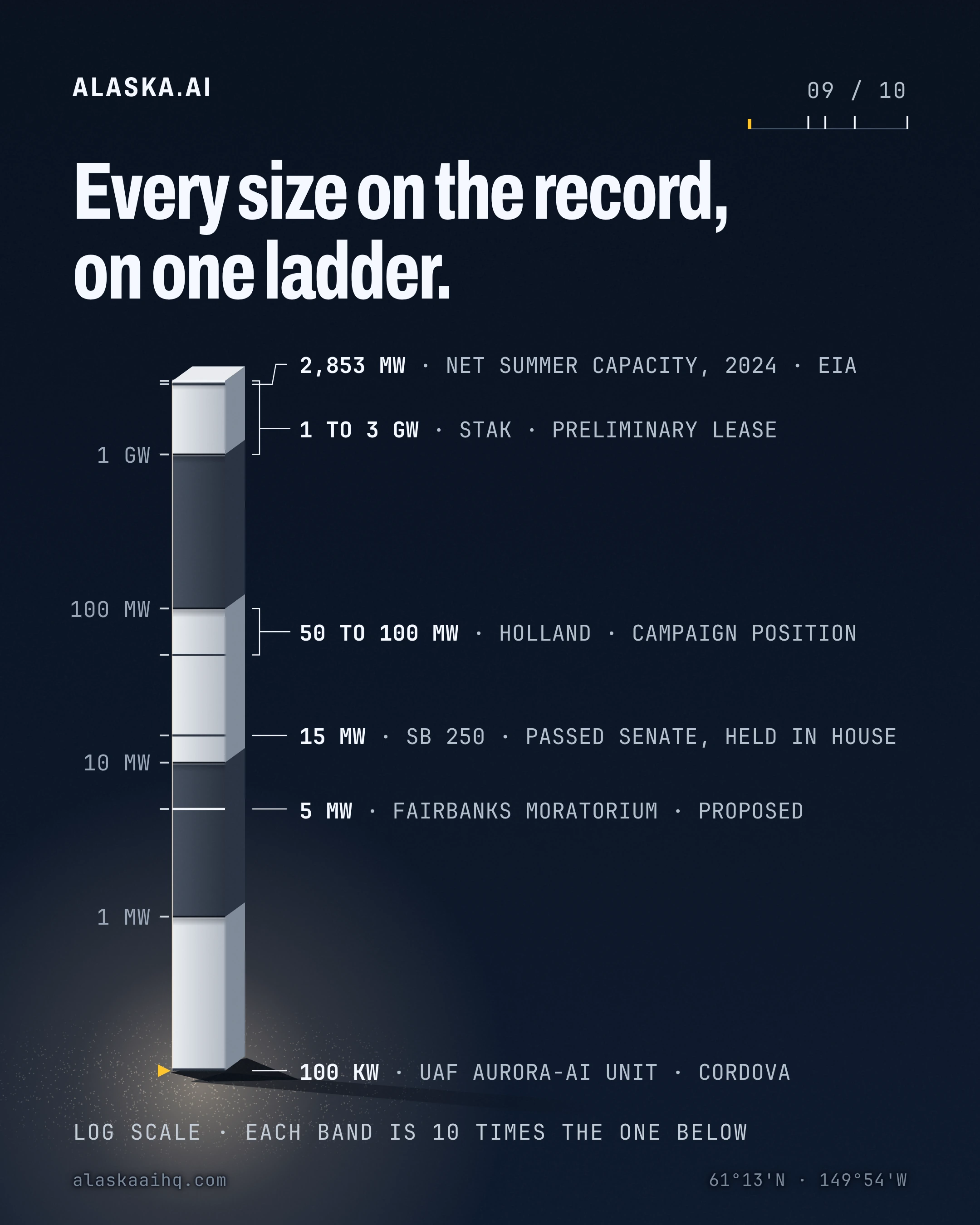
Independent Rep. Ky Holland wants data centers of 50 to 100 MW. Republican John Boyle, STAK Energy's chief strategy officer, is open to big ones on the North Slope. ADN describes STAK's project as 3 gigawatts, 30 times Holland's top size.
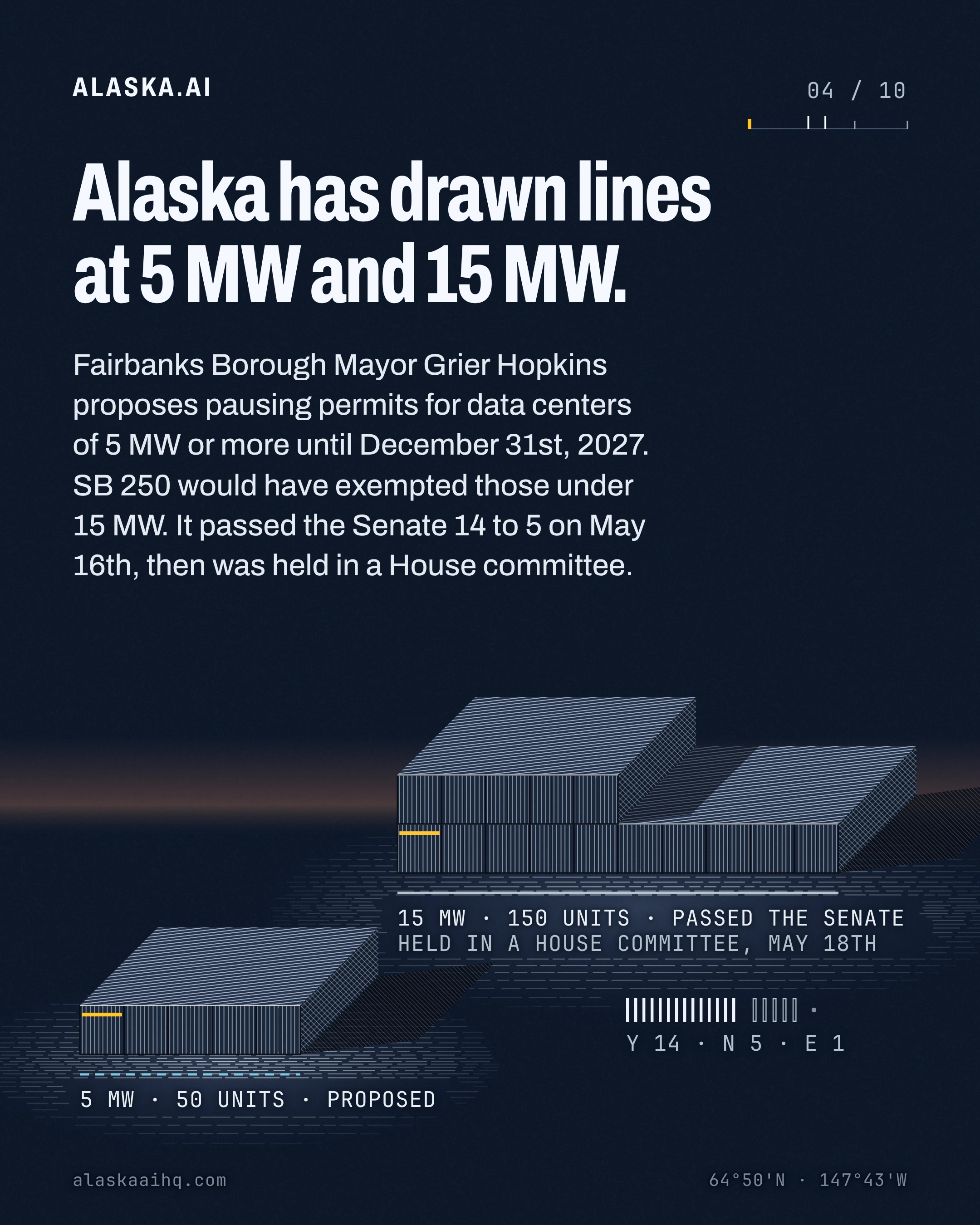
Alaska's own lines sit far lower. On May 16th the Senate passed SB 250's 15 MW line. On May 18th a House committee held it. Fairbanks' borough mayor now proposes a 5 MW permit pause. District 9 votes Tuesday, November 3rd.
A box of about 100 kW is the unit, stacked to every size on record, with maps of District 9 and the Slope lease.
Both candidates say a big customer could spread energy costs among more users. Would you want one on your grid at 100 MW, and at a gigawatt?
What we verified
78 CLAIMS, EACH RE-FETCHED FROM ITS SOURCE BEFORE THIS DECK SHIPPED
The Alaska Division of Elections lists Ky Holland, with the party label NON, as a candidate in the House District 9 general election contest.
The Alaska Division of Elections lists John C. Boyle, with the party label REP, as a candidate in the House District 9 general election contest.
Ky Holland is a co-chair of the House Energy Committee of the 34th Alaska Legislature.
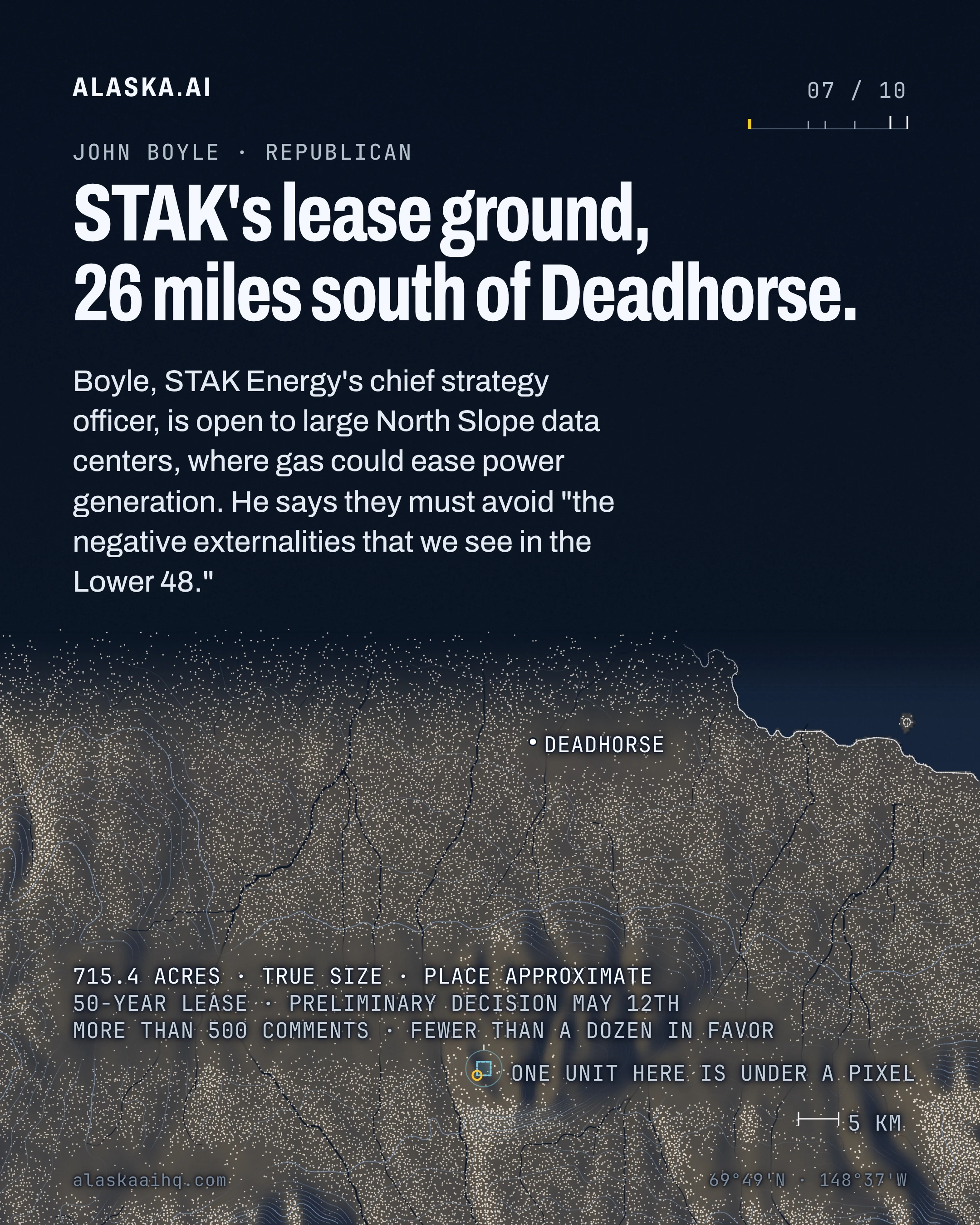
Alaska DNR published a preliminary decision to lease state land to STAK Energy Corporation under ADL 422741 on May 12th.
The DNR preliminary decision would offer STAK Energy a 50-year lease.
The STAK lease parcel covers 715.4 acres.
The STAK lease site lies next to the Dalton Highway about 26 miles south of Deadhorse.
The DNR notice describes the proposed use as a commercial natural gas-powered energy facility including modular high-performance computing units.
DNR extended public comment on the STAK lease to 4:30 p.m. on July 17th.
The original comment deadline on the STAK lease was June 15th.
The Senate-passed version of SB 250 does not apply to data centers that draw less than 15 megawatts of peak power demand from an electric utility.
The Alaska Senate passed CSSB 250(CRA) on reconsideration by 14 to 5 on May 16th.
The House Community and Regional Affairs Committee heard and held SB 250 on May 18th.
HB 259, titled Large Energy Use Facilities, was sponsored by Rep. Donna Mears.
The House Energy Committee heard and held HB 259 on January 29th.
The House Energy Committee heard and held HB 259 again on February 3rd, its last recorded action.
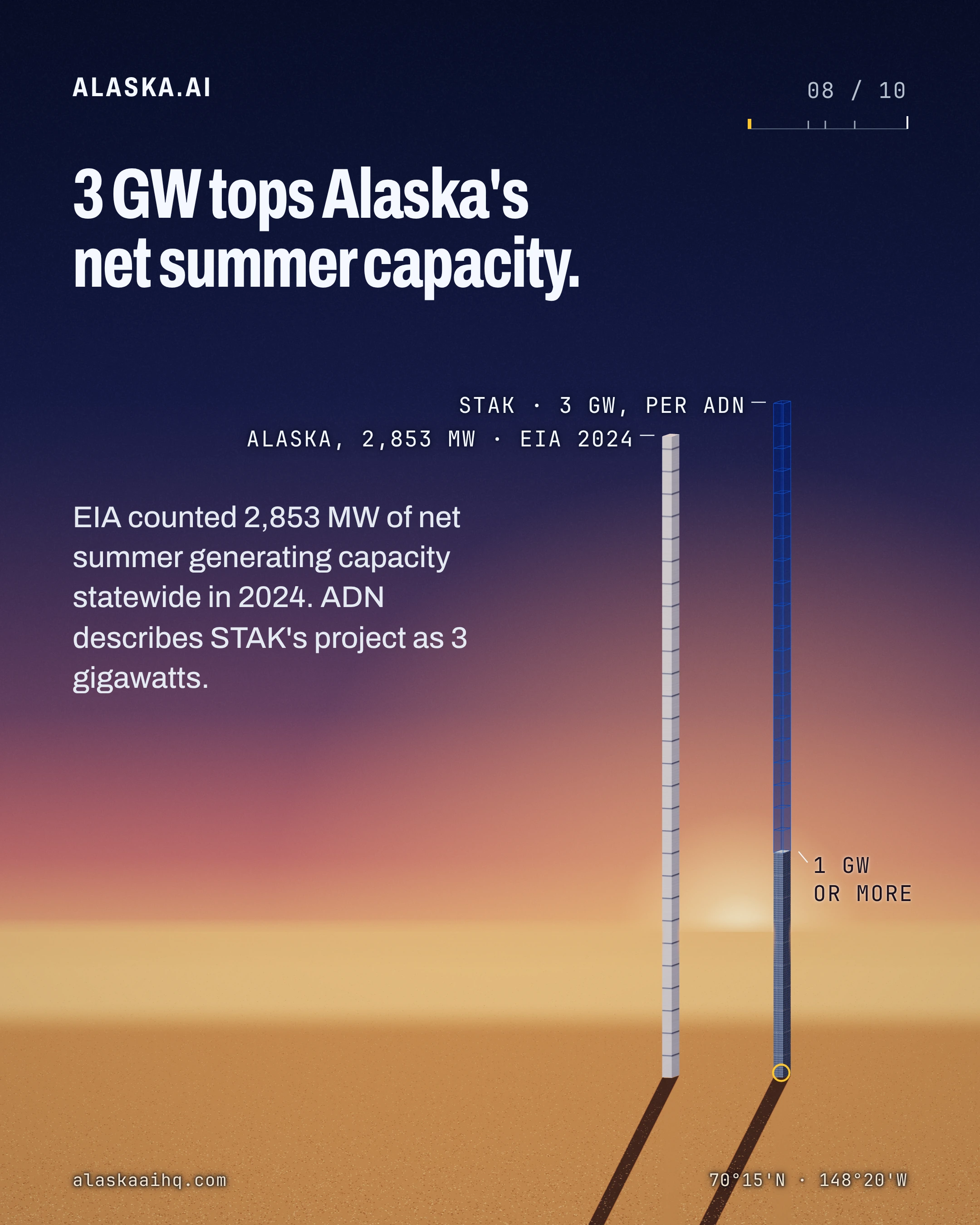
Alaska's net summer electric generating capacity was 2,853 megawatts in 2024.
The FCC approved with conditions the transfer of control of Quintillion Subsea Operations' cable landing license to GCI Holdings.
The FCC adopted and released order DA 26-1124 on October 20th.
The FCC denied ACS Communications' petition to deny the GCI and Quintillion application.
The Quintillion system lands at Prudhoe Bay, Barrow, Wainwright, Point Hope, Kotzebue and Nome.
The Quintillion system has three fiber pairs and six cable landing station sites.
The Quintillion system is 1,176 miles long.
GCI is acquiring Quintillion at a $310 million enterprise value, subject to adjustments.
GCI Holdings will reimburse up to $50 million of qualifying capital spending on Quintillion's Nome to Homer Express project.
The transaction includes upgrading the Quintillion-GCI network gateways from 10 Gbps to 100 Gbps.
The FCC cited growing competition from low Earth orbit satellite providers, particularly Starlink.
Under the conditions, GCI may seek an inflation-based price adjustment on contract extensions only after three years from closing and only when yearly inflation exceeded 5 percent.
GCI committed to offer open access to the rural portion of the Quintillion network.
GCI must file its wholesale contracts with the FCC for seven years after closing.
GCI must file all other contracts with the FCC for five years after closing.
Rep. Ky Holland, a one-term independent, is seeking to keep his South Anchorage House seat against Republican John Boyle in the November 3rd general election.
John Boyle is a former commissioner of the Alaska Department of Natural Resources.
House District 9 spans South Anchorage, the Lower Hillside, Girdwood and Whittier.
Holland led Boyle 59.9 percent to 40.1 percent in their head-to-head August primary contest.
Nearly 44 percent of registered voters in the district cast a ballot in the August primary.
District 9 primary turnout was 16 points higher than the state average.
Holland previously worked on building data centers in the Lower 48.
Holland called enormous hyperscale data centers "a fantasy idea" in Alaska.
Holland envisions Alaska data centers in the 50 to 100 megawatt range.
ADN describes STAK Energy's proposed North Slope project as a 3 gigawatt project.
Holland said he is excited about purpose-built, strategic, modest-sized, more traditional data centers.
Holland said worrying about hyperscale data centers is distracting Alaska from practical projects.
Holland said he is tired of Alaska wasting billions of dollars on megaprojects.
Holland cites limited data bandwidth, distance from major markets and infrastructure challenges as obstacles to hyperscale projects in Alaska.
John Boyle is chief strategy officer at STAK Energy.
STAK Energy is an Anchorage-based company specializing in Arctic energy infrastructure.
Boyle is more open to large-scale data centers, especially on the North Slope where natural gas access could ease power generation.
Boyle cautioned against overlooking data center problems elsewhere, including competition for land and water.
Boyle said data centers in Alaska must avoid the negative externalities seen in the Lower 48.
Boyle pointed to Juneau, where industrial demand from the Greens Creek and Kensington mines helps support the hydropower grid.
Both candidates say large industrial customers could help spread energy costs among more users.
Gas industry leaders say Southcentral Alaska may need imported LNG or North Slope gas by winter 2029.
More than 500 public comments on the STAK lease reached DNR before the preliminary deadline.
Fewer than a dozen of the public comments on the STAK lease endorsed the project.
Boyle said the North Slope project would cost more than $10 billion.
The STAK project's generators could produce a gigawatt or more of power, according to Anchorage Press.
Sen. Löki Tobin, an Anchorage Democrat, sponsored SB 250.
Each modular data center in UAF's AURORA-AI project is about 100 kilowatts, according to UAF professor Richard Wies.
UAF's AURORA-AI project is being done with the Cordova Electric Cooperative.
The Fairbanks North Star Borough mayor's proposed moratorium defines a large-scale data center as one with 5 megawatts or more of aggregate peak demand.
The proposed Fairbanks moratorium also covers data center operations occupying more than 50,000 square feet.
As written, the proposed Fairbanks ordinance would halt permits for large data centers until December 31st, 2027.
Fairbanks North Star Borough Mayor Grier Hopkins proposed the temporary data center moratorium.
Kenai Peninsula Borough Mayor Peter Micciche called the underwater data center approach sloppy at this stage.
The Cook Inlet proposal calls for 330 to 350 marine hydrokinetic turbines.
The Cook Inlet proposal includes 66 modular subsea compute hives.
The Cook Inlet proposal includes a 3.5-mile, 115 kV subsea power and fiber cable.
There are 20 proposed hyperscale data center sites in Alaska, according to Northern Center.
The Department of the Air Force is offering 9,417 acres for up to 12 commercial data centers.
About 300 Cook Inlet beluga whales remain, according to NOAA as cited by KTUU.
The Center for Biological Diversity filed on September 1st to intervene against DeepGreen's preliminary permit.
About 150 Fairbanks residents attended a data center town hall at the Wedgewood Resort.
The Northern Alaska Environmental Center, Families Over Billionaires and Native Movement were among the town hall hosts.
Legislators Scott Kawasaki, Maxine Dibert, Mike Prax and David Guttenberg attended the Fairbanks town hall.
Organizer Sarah Hollister said the largest concern is that nobody asked residents.
Attendee Randy Griffin spoke in favor, saying every bit of development helps Alaska's economy.
Attendee Aimee Moore called for very strict regulations on data centers.
Beats
This article is on Alaska data centers · Alaska power and the grid · Alaska land and permitting for AI · Alaska AI policy and legislation. Each beat page keeps every decision and every article on that subject in one place.